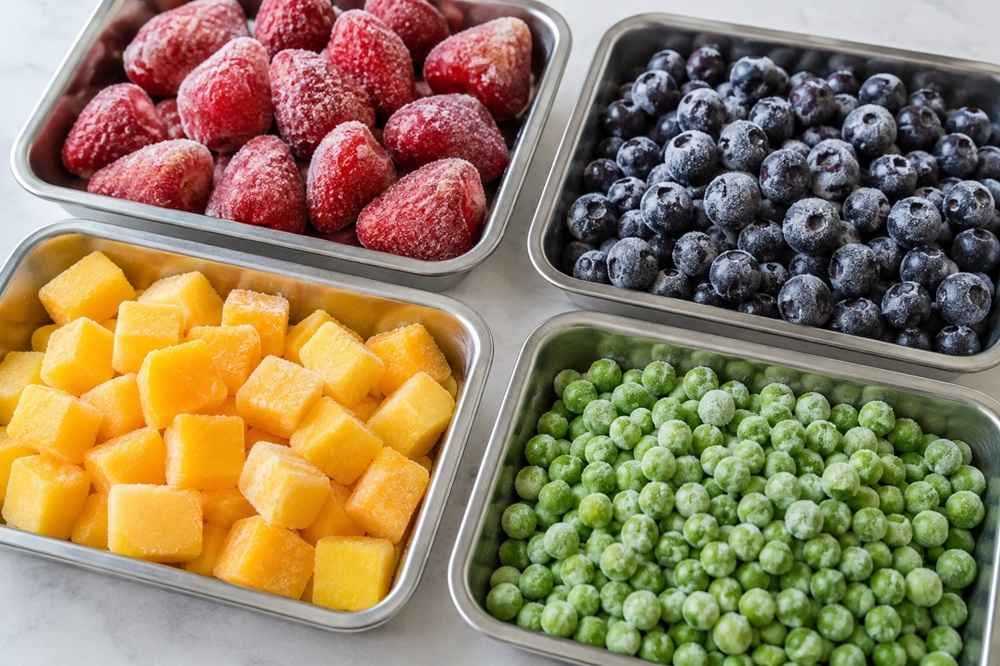
IQF significa congelamento rápido individual. O processo congela pedaços separados de alimentos rapidamente e os mantém fluindo livremente, para que os usuários possam pegar a porção necessária sem descongelar um bloco inteiro. Exemplos comuns incluem frutas vermelhas, ervilhas, pedaços de manga e camarão.
A produção bem-sucedida do IQF requer mais do que ar frio. Preparação do produto, separação, tempo de congelamento, embalagem e armazenamento refrigerado afetam o resultado final. Este guia explica o processo e as verificações que ajudam os compradores a comparar equipamentos.
Quais alimentos atendem ao IQF?
O IQF funciona em diversas categorias de alimentos. Comece com o formato do produto, necessidades de tamanho e manuseio, em seguida, confirme o processo por meio de um teste.
| Categoria de alimentos | Exemplos comuns | Perguntas a serem feitas antes de um julgamento |
|---|---|---|
| Fruta | Morangos, mirtilos, cubos de manga, fatias de pêssego | Qual faixa de tamanho e maturação a produção suportará? Quanta quebra o comprador pode aceitar? |
| Vegetais | Ervilhas, grãos de milho, florzinhas de brócolis, cenouras em cubos | O produto precisa de branqueamento? Como a linha controlará as águas superficiais? |
| Frutos do mar | Camarão, vieiras, anéis de lula, porções de peixe | A linha lidará com produtos crus ou cozidos?? A especificação inclui vidros? |
| Carnes e aves | Frango em cubos, tiras de carne, almôndegas | Qual espessura, teor de gordura e condição da superfície o ensaio representará? |
| Queijo | Pedaços de mussarela, cubos de queijo adequados | Como o sistema evitará a aderência e manterá a forma necessária da peça? |
| Ervas | Salsa picada, coentro e ervas semelhantes | Como a linha irá lidar com peças leves e limitar multas? |
Um teste bem-sucedido com um alimento não prova desempenho igual em outro.
O mesmo freezer pode fornecer resultados diferentes para ervilhas, morangos inteiros e cubos de manga. Compare os valores de capacidade apenas quando os fornecedores declaram o produto e as condições operacionais.
Como funciona o IQF?
O congelamento rápido limita o crescimento de grandes cristais de gelo. Em um sistema de leito fluidizado, o fluxo de ar frio ascendente também levanta e separa peças adequadas. Esta combinação ajuda a proteger a textura e manter a separação.
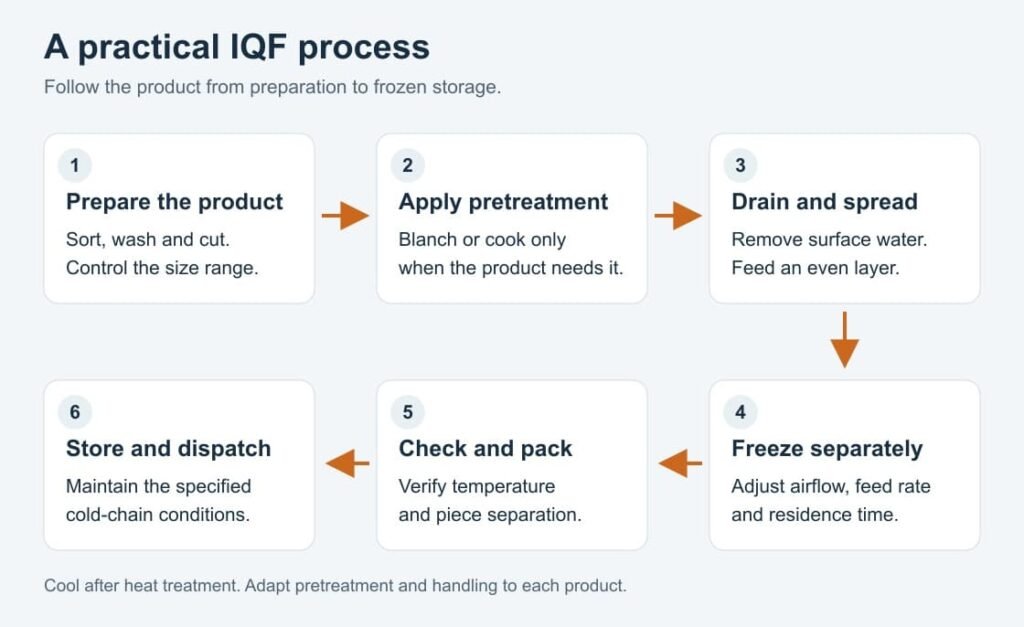
1. Prepare o produto
Classifique a matéria-prima, remover defeitos, e lavar, descasque ou corte conforme o produto exigir. Controle a faixa de tamanho para suportar um congelamento consistente.
Grandes variações na espessura tornam mais difícil atingir uma temperatura consistente do produto em um único tempo de residência.
2. Aplicar pré-tratamento adequado
Alguns vegetais precisam de branqueamento seguido de resfriamento. Cozinhe os produtos apenas quando a receita assim o exigir.
Combine o tratamento com a comida. Um processo para camarão cozido será diferente de um processo para camarão cru ou frutas frescas.
3. Escorra e espalhe
Remova o excesso de água superficial e coloque uma camada uniforme no freezer. Verifique o avanço em toda a largura de trabalho.
O carregamento irregular pode restringir o fluxo de ar e criar condições de congelamento inconsistentes. O excesso de água superficial também pode contribuir para a aderência e o acúmulo de gelo.
4. Congelar peças individuais
Ajustar o fluxo de ar, taxa de alimentação e tempo de permanência no produto.
Alguns sistemas usam uma zona inicial de congelamento da crosta para firmar a superfície antes do congelamento mais profundo. Combine o método de separação com o peso do produto, tolerância de forma e manuseio.
5. Verifique e embale
Verifique os critérios de temperatura e separação, inspecionar o produto, e embale imediatamente.
Verifique o resultado sob condições de produção representativas. Algumas boas amostras de uma carga leve não estabelecem desempenho de capacidade total.
6. Armazenar e Despachar
Mova as embalagens para armazenamento congelado controlado e mantenha a cadeia de frio até a entrega.
Coordenar a descarga do freezer, capacidade de embalagem e armazenamento para evitar filas de produtos em áreas quentes.
O que é o congelador IQF?
O freezer IQF remove o calor rapidamente enquanto seu fluxo de ar e sistema de manuseio ajudam a manter as peças separadas. Os compradores devem distinguir o método de resfriamento do layout do equipamento.
Sistemas mecânicos use um circuito de refrigeração para remover o calor. Sistemas criogênicos use um criogênio consumível, como nitrogênio líquido ou dióxido de carbono.
| Termo do equipamento | O que descreve | O que confirmar |
|---|---|---|
| Congelador de leito fluidizado | O fluxo de ar ascendente levanta e separa peças adequadas | Tamanho do produto, peso, pegajosidade e tolerância ao manuseio |
| Congelador de correia ou túnel | Um transportador transporta alimentos através de um compartimento de congelamento | Profundidade do leito, tempo de residência e método de separação |
| Congelador espiral | Um transportador em espiral fornece um longo caminho de correia em uma área compacta | Suporte ao produto, pontos de transferência e o resultado de congelamento necessário |
| Congelador criogênico | Um sistema usa nitrogênio líquido ou dióxido de carbono para resfriamento | Consumo de criogênio, fornecer, requisitos de exaustão e local |
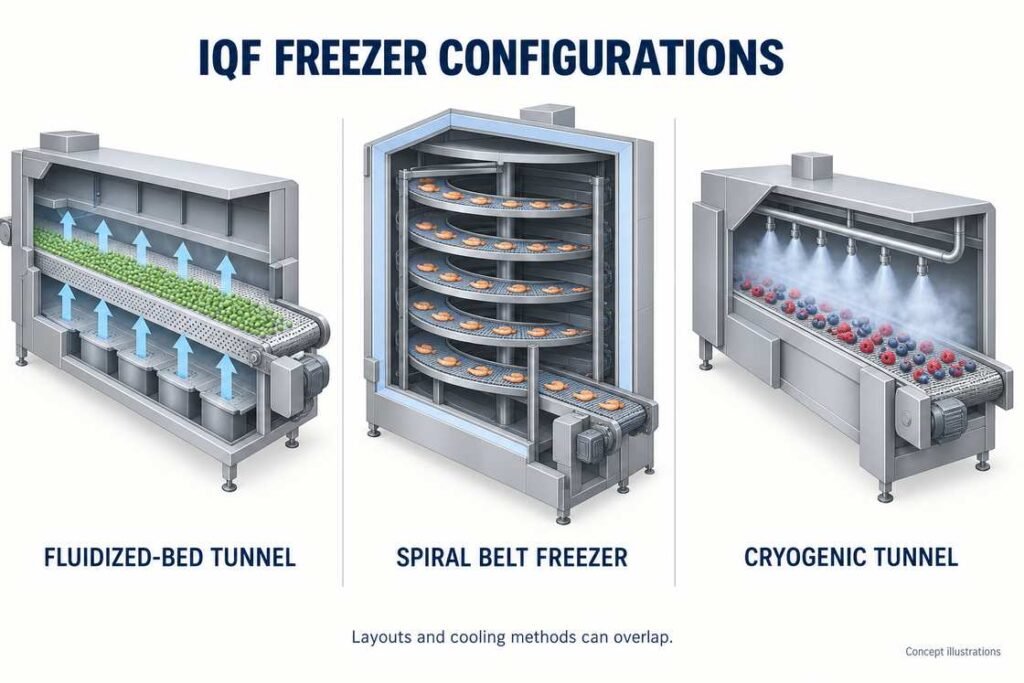
Essas categorias se sobrepõem. Um túnel pode usar resfriamento mecânico ou criogênico. Um layout de túnel ou espiral por si só não garante um resultado IQF.
Confirme o desempenho de separação e temperatura com o produto pretendido.
Que temperatura o congelamento IQF exige?
IQF não tem temperatura de freezer universal única.
Uma especificação útil separa a temperatura dos alimentos, a temperatura do ar e a temperatura de evaporação do refrigerante.
| Temperatura | O que isso te diz | Como usar |
|---|---|---|
| Temperatura de alimentação do produto | A temperatura dos alimentos antes de congelar | Inclua-o em todas as comparações de capacidade |
| Temperatura do ar do congelador | A temperatura do ar ao redor do produto | Identifique o local de medição e a condição operacional |
| Temperatura de evaporação | A temperatura de saturação do refrigerante na pressão de evaporação | Use-o ao verificar a capacidade de refrigeração; não substitua pela temperatura do ar |
| Temperatura do centro térmico do produto | O ponto mais quente dentro do alimento no final do congelamento | Verifique-o em relação ao ponto final de congelamento acordado |
| Temperatura do ar na sala de armazenamento | A condição do ar durante o armazenamento congelado | Defina e monitore-o para manter a temperatura necessária do produto |
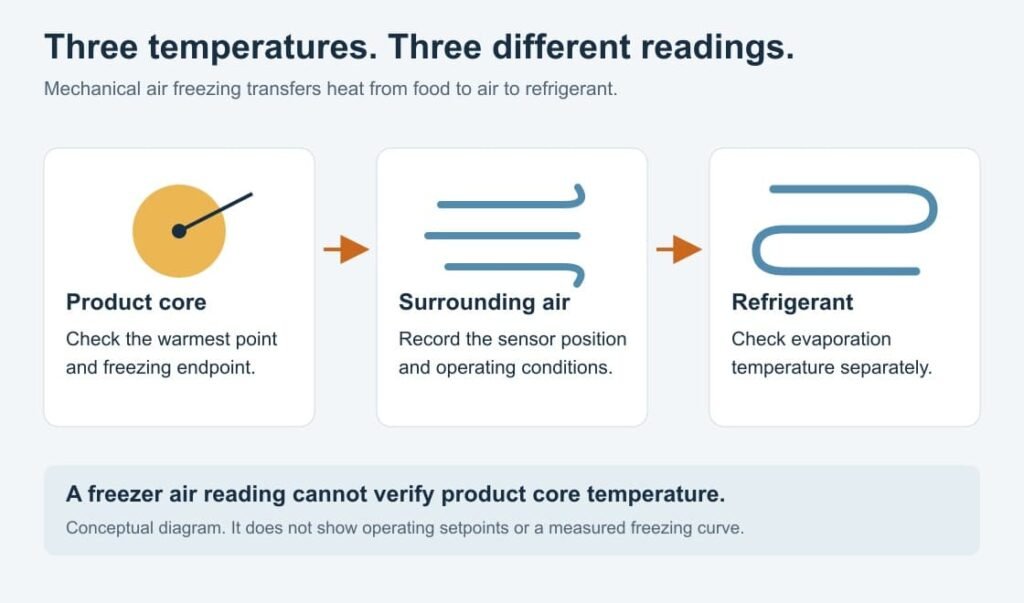
Para alimentos ultracongelados, −18°C ou mais frio no centro térmico após estabilização da temperatura fornece um benchmark comum de conclusão de congelamento. Confirme a especificação do produto aplicável e os requisitos de destino.
Este benchmark descreve a temperatura dos alimentos. Não prescreve a configuração de ar do freezer.
Por exemplo, uma especificação de capacidade pode indicar:
- Temperatura de alimentação do produto: +15°C.
- Temperatura de saída do produto: −18ºC.
- Temperatura de evaporação do refrigerante: −38ºC.
Esses números descrevem diferentes condições. O valor de evaporação de -38°C não significa que o ar do congelador ou o núcleo do produto também atinja -38°C.
Quanto tempo leva o congelamento do IQF?
Espessura do produto, composição, temperatura inicial, o fluxo de ar e o carregamento afetam o tempo de congelamento.
Confirme a duração por meio de uma avaliação do produto. Registre o tempo de residência e a temperatura mais quente do produto; um temporizador sozinho não pode verificar o endpoint.
Peça ao fornecedor para explicar o método de amostragem, localização da sonda e tempo de medição. Use o mesmo método durante o teste de aceitação.
Qual é a diferença entre IQF e congelamento rápido?
IQF descreve congelamento e separação rápidos individuais. O congelamento por jato de ar descreve um método de transferência de calor que usa ar frio em movimento rápido. Um freezer IQF de leito fluidizado pode, portanto, usar congelamento por jato de ar.
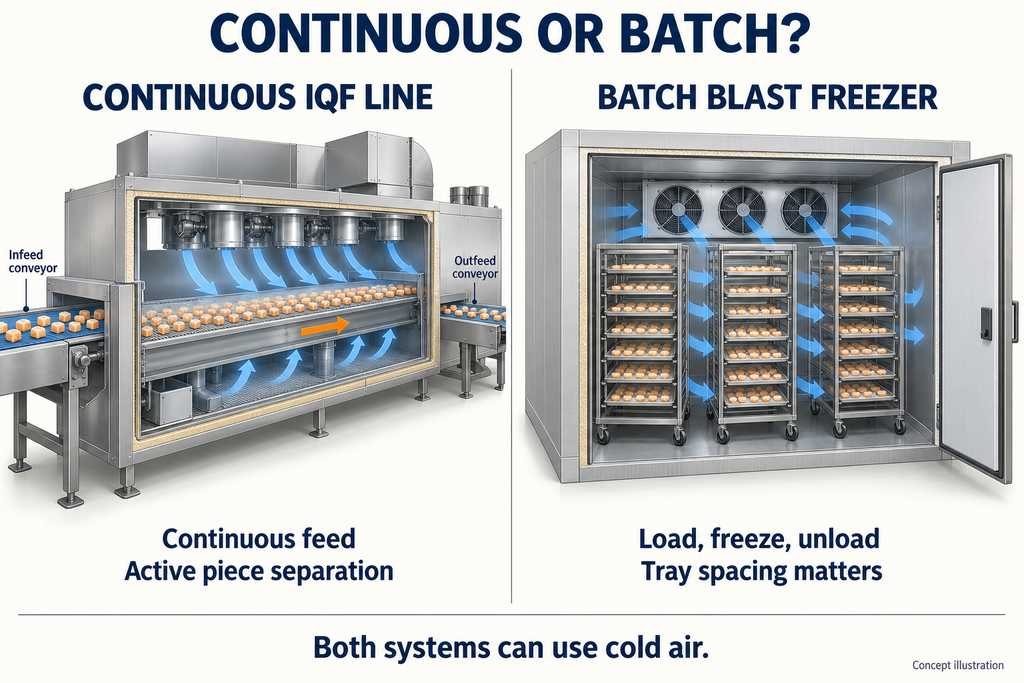
Para decisões de compra, uma comparação mais útil geralmente envolve uma linha IQF contínua e um freezer em lote.
| Ponto de comparação | Linha IQF contínua | Congelador em lote |
|---|---|---|
| Movimento do produto | Um transportador ou leito move o produto através do sistema | Operadores carregam e descarregam lotes em bandejas, racks ou carrinhos |
| Separação | A linha gerencia ativamente a separação de peças | O espaçamento e o carregamento das bandejas ajudam a determinar a separação |
| Ajuste de produção | Produção repetida com alimentação consistente | Programações de lote e alteração de cargas |
| Verificação de capacidade | Verifique kg/h nas condições declaradas do produto | Verifique kg/lote e o ciclo completo de carga a carga |
| Principais questões do teste | As peças permanecem separadas? A linha atende às metas de temperatura e produção? | Cada bandeja atende ao ponto final? O padrão de carregamento permite fluxo de ar adequado? |
Alguns sistemas em lote podem congelar peças individuais com sucesso. Da mesma maneira, uma linha IQF pode lidar com produção em escala industrial.
Escolha equipamentos em torno do produto, cronograma de produção, requisitos de separação e capacidade verificada. Etiquetas como “lote pequeno,” “lote grande” ou “mais preciso” fornecem muito pouca informação para uma comparação sólida.
Embalagem IQF: O que você deve verificar?
A embalagem IQF deve proteger a qualidade do produto, mantendo as porções individuais convenientes para uso.
A queimadura do congelador envolve perda de umidade da superfície. Um pacote adequado ajuda a controlar essa perda, mas não pode compensar o mau gerenciamento da temperatura.
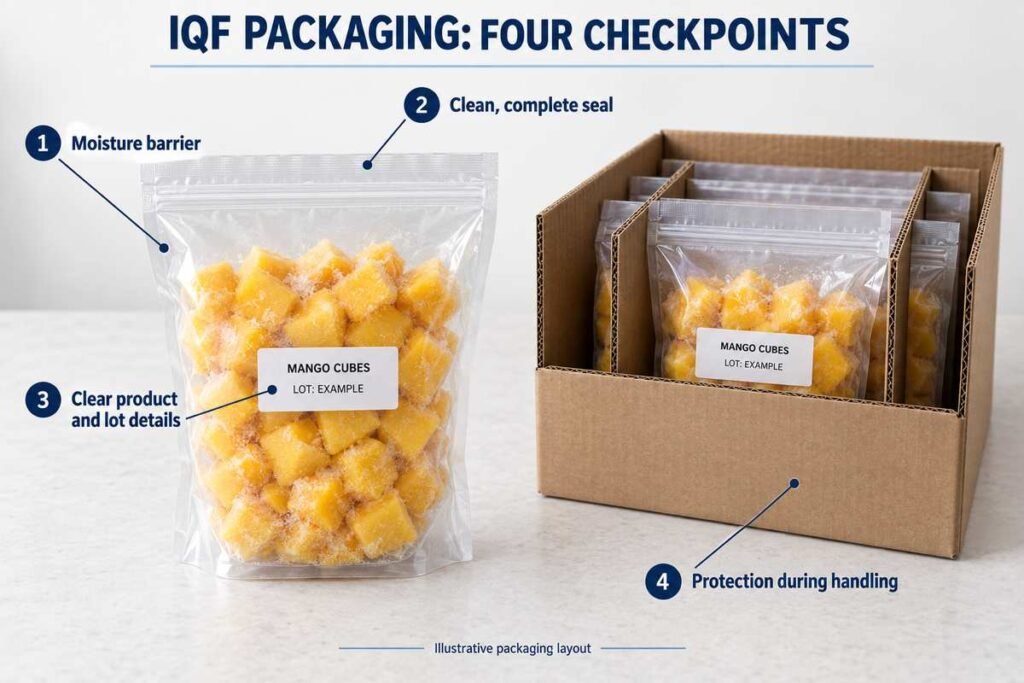
Use esta lista de verificação ao discutir embalagens com um fornecedor de embalagens:
| Verificar | Pergunta prática |
|---|---|
| Barreira de umidade | O fornecedor fornece dados de transmissão de vapor de água e condições de teste relevantes? |
| Proteção de oxigênio | O produto precisa de proteção adicional contra oxidação ou alterações de sabor?? |
| Resistência a baixas temperaturas | O filme resistirá a rachaduras, perfurações e danos por manuseio na temperatura pretendida? |
| Desempenho do selo | A linha de enchimento pode manter fragmentos de produto e gelo fora da área de vedação?? |
| Tamanho do pacote | O formato suporta o tamanho da porção e o método de manuseio do comprador?? |
| Proteção de manuseio | A caixa externa e o arranjo de empilhamento protegerão peças delicadas? |
1.Selecione a embalagem para o produto real
Peça ao fornecedor para confirmar a adequação do contato com alimentos para o alimento pretendido e para o mercado.
Teste o pacote realmente preenchido por meio de vedação, armazenamento refrigerado e manuseio. O nome ou a espessura do filme por si só não pode estabelecer o desempenho da embalagem.
2.Controle de enchimento e selagem
Limitar o aquecimento do produto durante a embalagem. Mantenha fragmentos do produto e gelo longe da área de vedação.
Verifique as vedações na inicialização e após as trocas. Inclua testes de manuseio de embalagens cheias ao qualificar um novo formato de filme ou embalagem.
3.Combine o tamanho do pacote com o comprador
Os compradores de varejo podem precisar de porções convenientes e de uma embalagem que possa ser fechada novamente. Os compradores industriais e de serviços de alimentação podem precisar de formatos maiores que se ajustem ao seu processo de distribuição ou produção.
Proteja produtos delicados contra compressão excessiva durante a embalagem, empilhamento e transporte.
4.Use rótulos claros e prazo de validade validado
Forneça uma identificação clara do produto, informações sobre lote, instruções de armazenamento e orientação de preparação. Peça ao revisor do rótulo que verifique os requisitos do mercado de destino.
Defina o prazo de validade por meio da validação específica do produto. Embalagem, a composição do produto e as condições da cadeia de frio influenciam a retenção da qualidade.
Escolha uma estrutura reciclável quando ela também atender aos requisitos de proteção do produto e coleta local. Verifique as declarações de reciclagem para o mercado de destino.
IQF vs.. Congelamento de câmara fria: O que muda depois do freezer?
Uma linha IQF remove o calor necessário para congelar os alimentos recebidos. Uma sala de armazenamento congelado mantém o produto na temperatura necessária após o congelamento.
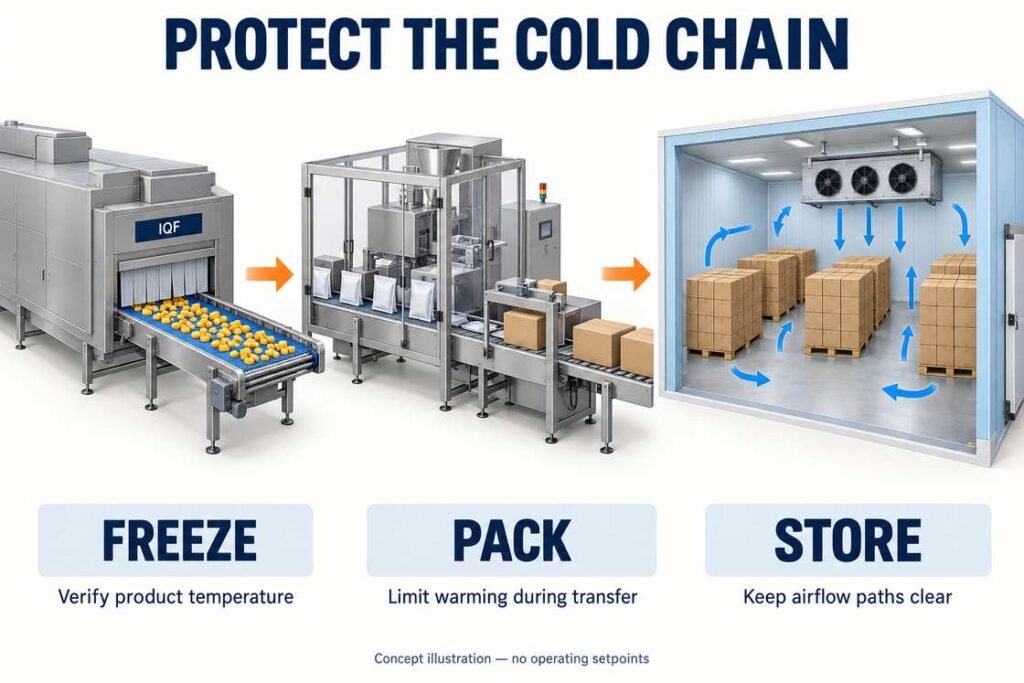
Uma sala de explosão especialmente construída pode realizar tarefas de congelamento, mas uma sala de espera comum pode não ter capacidade e fluxo de ar para a mesma carga.
| Sistema | Tarefa principal | Principais entradas de design |
|---|---|---|
| IQF line | Congele peças individuais e mantenha a separação | Dimensões do produto, temperatura de alimentação, saída horária e ponto final de congelamento |
| Sala de congelamento | Congelar um lote dentro de um ciclo definido | Peso do lote, padrão de carregamento, fluxo de ar e tempo de ciclo |
| Sala de armazenamento de congelados | Manter a temperatura do produto congelado recebido | Temperatura de chegada do produto, inventário, tráfego de portas e condições ambientais |
Para alimentos IQF, projetar condições de armazenamento para manter a temperatura necessária do produto, comumente −18°C ou mais frio. Confirme a especificação do produto aplicável e os requisitos de destino.
Antes de dimensionar a câmara fria, documento:
- Ingestão diária de produto e temperatura de chegada.
- Quantidade máxima de armazenamento.
- Embalagem e disposição de paletes.
- Frequência de abertura de porta e tempo de manuseio.
- Temperatura ambiente e umidade.
- Requisitos de monitoramento de temperatura e alarme.
Mantenha caminhos de fluxo de ar desobstruídos em torno de chaminés e evaporadores. Incluir embalagem e expedição no plano de controle de temperatura.
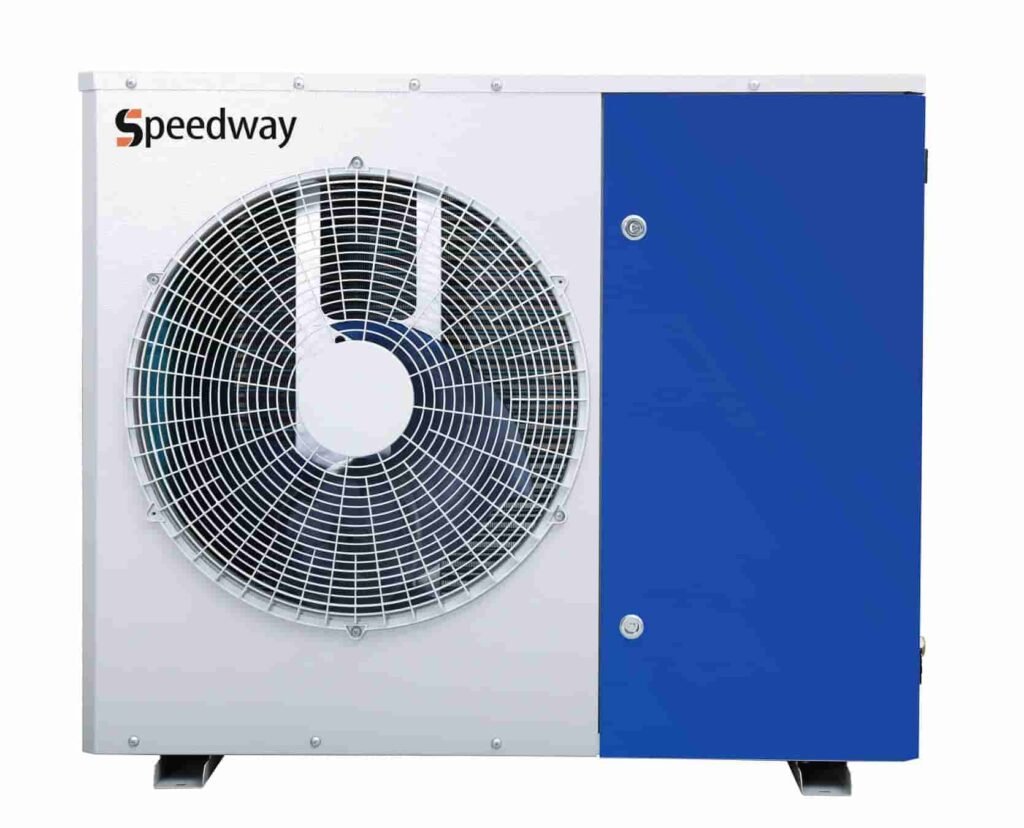
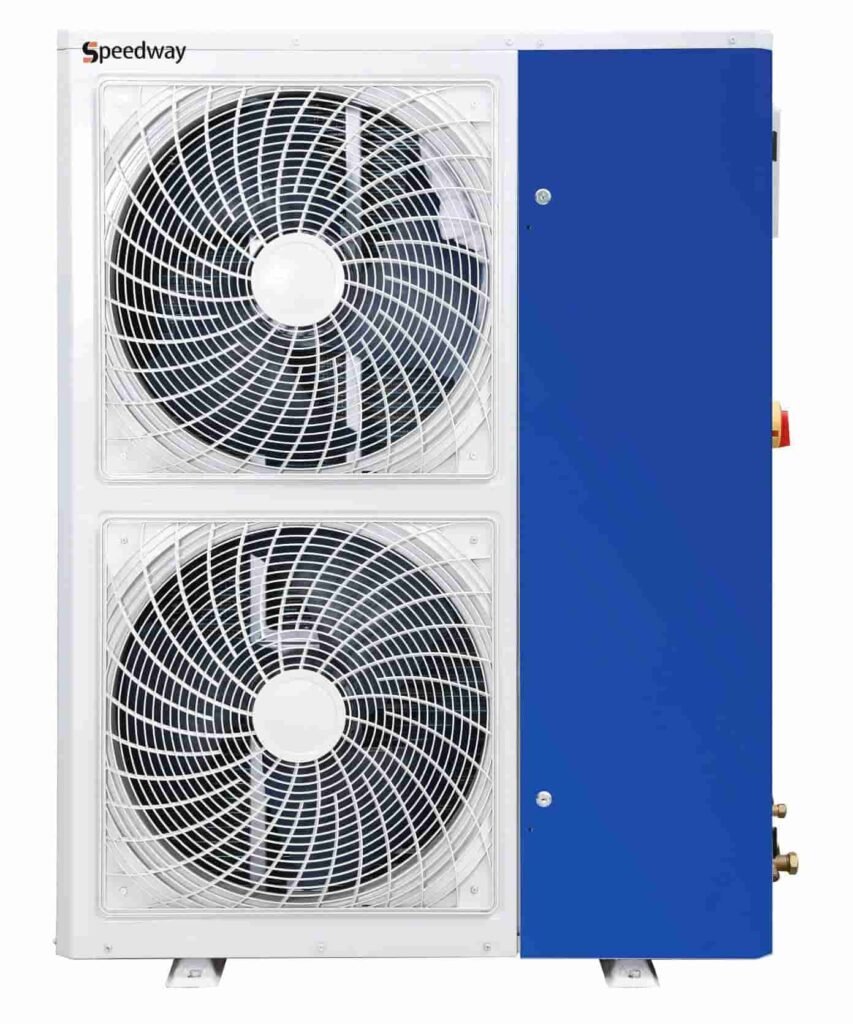
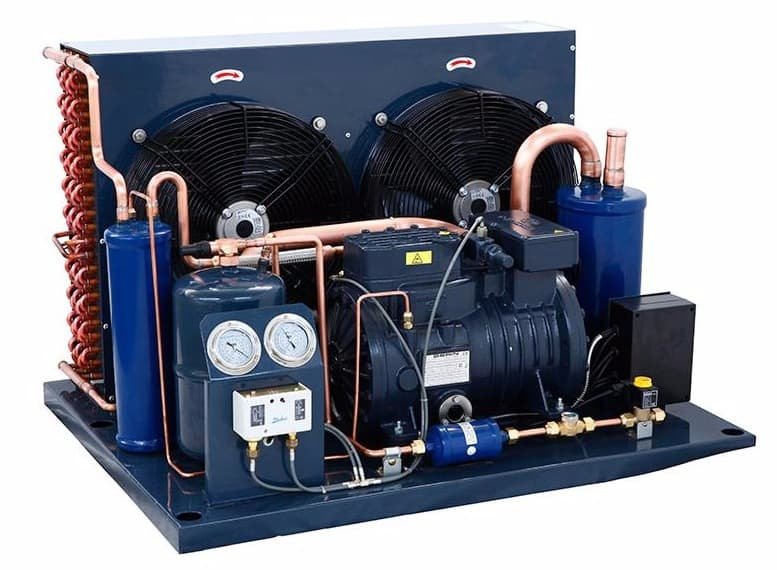
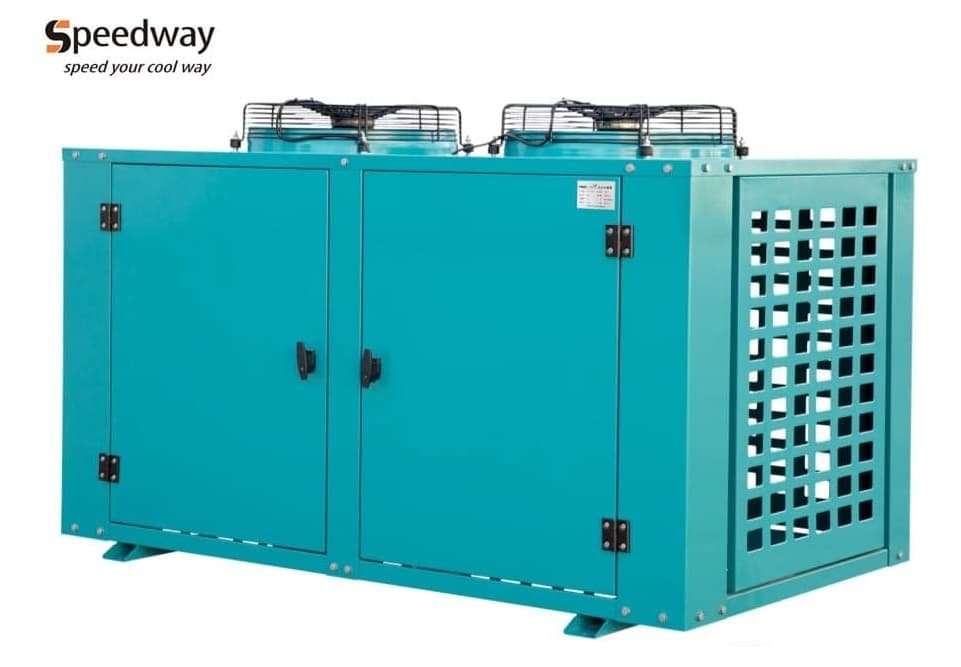
PERCEBER: Se o seu projeto precisar de armazenamento downstream, avaliar o Speedway's soluções para câmaras frigoríficas e unidades de condensação juntamente com as condições de descarga do produto do freezer.
Como comparar equipamentos IQF e custos operacionais?
Dê a cada fornecedor o mesmo resumo do produto:
| Especificação | Informações a fornecer |
|---|---|
| produtos | Tipo de comida, dimensões da peça e faixa de tamanho |
| Condição de alimentação | Temperatura, águas superficiais e pré-tratamento |
| Meta de produção | Kg/h necessários e horas diárias de produção |
| Ponto final de congelamento | Temperatura alvo do produto e método de medição |
| Limites de qualidade | Aglomeração aceitável, quebra e perda de peso |
| Condições do local | Espaço disponível, utilidades e condições ambientais |
| Cronograma operacional | Limpeza, expectativas de mudança e degelo |
1.Compare os custos operacionais completos
Sistemas mecânicos consomem eletricidade em refrigeração e auxiliares. Os sistemas criogênicos também requerem um fornecimento contínuo de criogênio.
Verifique ambas as opções em relação aos preços locais e ao cronograma de produção esperado. Incluir mão de obra, limpeza, tempo de parada de manutenção e produção na comparação.
2.Defina a medição de energia
Para uma comparação de eletricidade, calcular:
Uso específico de eletricidade (kWh/kg) = eletricidade dentro dos limites acordados do sistema ÷ produção de produto aceitável durante o mesmo período.
Indique se o limite inclui:
- Compressores.
- Ventiladores do evaporador e condensador.
- Bombas.
- Transportadores.
- Descongelar.
- Outros auxiliares relevantes.
Não compare o valor apenas do ventilador de um fornecedor com o valor completo de refrigeração de outro fornecedor.
Para equipamentos criogênicos, registre também o consumo de criogênio por quilograma de produto aceitável e aplique o custo de fornecimento local.
3.Verifique o desempenho por meio de uma avaliação do produto
No julgamento, registrar configurações operacionais, resultados de temperatura, saída aceitável, aglomerados, quebra e uso de energia.
Combine o método de amostragem e os limites de aceitação antes do teste. Mantenha as mesmas definições ao comparar fornecedores.
Um teste útil deve responder 3 questões:
- O produto atende à meta de temperatura?
- Atende aos limites de separação e qualidade?
- O sistema pode manter a saída necessária sob condições operacionais representativas??
Registro de teste de produto IQF
DADOS SIMULADOS — SOMENTE PARA PLANEJAMENTO
Este exemplo usa condições hipotéticas de corte e congelamento de manga. Não representa um teste real do Speedway ou desempenho verificado do equipamento. Os limites de aceitação ilustram um possível acordo entre comprador e fornecedor; eles não constituem padrões universais da indústria.
1.Produto e condições operacionais
| Parâmetro | Especificação de exemplo |
|---|---|
| Referência de teste | IQF-MANGO-DEMO-001 |
| produtos | Cubos de manga |
| Dimensões nominais do cubo | 15 × 15 × 15 milímetros |
| Tolerância de tamanho | ±2 mm por dimensão |
| Preparação do produto | Casca, dados, inspecionar e drenar |
| Condição da superfície | Nenhuma água parada visível na alimentação |
| Vidros | Nenhum |
| Configuração do freezer | Túnel mecânico contínuo IQF com controle de separação de produtos |
| Temperatura de alimentação do produto | +8Meta de °C |
| Configuração da temperatura do ar do freezer | −35°C |
| Temperatura de evaporação do refrigerante | −42°C, condição operacional assumida |
| Tempo nominal de residência do produto | 12 minutos |
| Período de avaliação | 60 minutos após as condições de operação se estabilizarem |
| Entrada do produto durante a avaliação | 500.0 kg |
| Abordagem de amostragem | Seis postos de controle; três leituras do núcleo do produto por ponto de verificação |
| Instrumento de temperatura | Sonda de penetração de ponta fina calibrada |
| Local de medição | Centro térmico de cubos representativos |
| Inspeção de qualidade | Classifique e pese o lote de produção correspondente completo |
2.Pontos de verificação de temperatura
O operador coleta amostras de três cubos representativos ao longo da largura de descarga em cada ponto de verificação. A coluna de tempo refere-se ao período de avaliação de descarga estabilizada.
| Ponto de verificação | Tempo | Temperatura de alimentação | Temperatura do ar na área de descarga | Leitura central 1 | Leitura central 2 | Leitura central 3 | Leitura central mais calorosa |
|---|---|---|---|---|---|---|---|
| 1 | 5 min | +7.9°C | −35,2ºC | −19,2°C | −18,8°C | −19,5°C | −18,8°C |
| 2 | 15 min | +8.1°C | −34,8ºC | −19,0ºC | −19,4°C | −18,6°C | −18,6°C |
| 3 | 25 min | +8.0°C | −35,4°C | −19,7°C | −19,1ºC | −19,6°C | −19,1ºC |
| 4 | 35 min | +8.2°C | −35,0ºC | −19,0ºC | −19,3°C | −18,9ºC | −18,9ºC |
| 5 | 45 min | +8.0°C | −34,9ºC | −19,1ºC | −18,7°C | −19,4°C | −18,7°C |
| 6 | 55 min | +7.8°C | −35,1ºC | −19,2°C | −18,8°C | −19,5°C | −18,8°C |
| Resumo de temperatura | Resultado simulado |
|---|---|
| Número de leituras do núcleo do produto | 18 |
| Temperatura média do núcleo do produto | −19,16ºC |
| Leitura mais calorosa do núcleo do produto | −18,6°C |
| Leitura mais fria do núcleo do produto | −19,7°C |
| Leituras iguais ou inferiores a −18°C | 18 de 18 |
Atenção: Cada amostra simulada atende ao limite do núcleo de descarga do exemplo. Um ensaio real também deve seguir o procedimento acordado de estabilização e verificação. Só dezoito leituras não conseguem estabelecer a temperatura de cada peça.
3.Recuperação de produtos e resultados de qualidade
Para este exemplo, a moita contém duas ou mais peças que permanecem presas após o teste de separação suave acordado. A pedaço quebrado falha no critério de forma ou tamanho acordado. Os inspetores usam amostras de referência para aplicar ambas as classificações de forma consistente.
Os inspetores classificam cada item uma vez. Eles atribuem grupos primeiro, em seguida, avalie o produto restante quanto a quebra.
| Medição | Resultado simulado | Cálculo ou definição |
|---|---|---|
| Entrada do produto | 500.0 kg | Entrada total de lote correspondente |
| Produção total recuperada | 496.0 kg | Produto aceitável mais aglomerados e pedaços quebrados |
| Aglomerados | 4.0 kg | Categoria de inspeção separada |
| Pedaços quebrados | 2.0 kg | Exclui produtos já contados como aglomerados |
| Produto aceitável | 490.0 kg | 496.0 - 4.0 - 2.0 |
| Diferença de massa de entrada-saída | 4.0 kg | 500.0 - 496.0 |
| Diferença de massa como parcela da entrada | 0.80% | 4.0 ÷ 500.0 × 100 |
| Taxa de aglomeração | 0.81% | 4.0 ÷ 496.0 × 100 |
| Taxa de quebra | 0.40% | 2.0 ÷ 496.0 × 100 |
| Rendimento aceitável do produto | 98.00% | 490.0 ÷ 500.0 × 100 |
| Taxa de transferência de entrada | 500.0 kg/h | 500.0 kg acima 60 minutos |
| Taxa de transferência de saída aceitável | 490.0 kg/h | 490.0 kg acima 60 minutos |
Não rotule o 0.80% diferença de massa como perda por desidratação sem medição adicional. Evaporação, lidar com perdas, material retido e incerteza de pesagem podem afetar a balança.
4.Exemplo de revisão de aceitação
| Item de aceitação | Limite ilustrativo | Resultado simulado | Avaliação de exemplo |
|---|---|---|---|
| Taxa de transferência de entrada | Pelo menos 500 kg/h | 500 kg/h | Atende ao limite de exemplo |
| Taxa de transferência de saída aceitável | Pelo menos 490 kg/h | 490 kg/h | Atende ao limite de exemplo |
| Núcleo de descarga amostrado mais quente | −18°C ou mais frio | −18,6°C | Atende ao limite de exemplo |
| Taxa de aglomeração | Não mais do que 1.00% da produção recuperada | 0.81% | Atende ao limite de exemplo |
| Taxa de quebra | Não mais do que 0.50% da produção recuperada | 0.40% | Atende ao limite de exemplo |
| Rendimento aceitável do produto | Pelo menos 98.00% de entrada | 98.00% | Atende ao limite de exemplo |
| Balanço de massa | Registre e investigue a diferença | 4.0 diferença de quilogramas | Requer reconciliação em um julgamento real |
| Produção contínua entre degelos | Teste de resistência separado | Não há dados de resistência | Nenhuma conclusão |
| Adequação microbiológica | Verificação separada da segurança do produto | Sem dados microbiológicos | Nenhuma conclusão |
Conclusão: A execução simulada satisfaz o rendimento ilustrativo, critérios de temperatura amostrada e qualidade física. Não estabelece desempenho de longo prazo, eficácia de limpeza, segurança alimentar ou aceitação de equipamentos comerciais.
Perguntas frequentes
Q1.O IQF mata bactérias?
Não trate o congelamento como uma etapa geral de eliminação microbiana. Alguns microrganismos sobrevivem ao congelamento e podem crescer quando as condições se tornam favoráveis.
Controle a higiene e os perigos relevantes em toda a produção. Siga as instruções de manuseio e cozimento do produto.
Q2.O IQF requer nitrogênio líquido?
Não. A refrigeração mecânica pode apoiar a produção IQF. Equipamento criogênico oferece outra rota de resfriamento.
Escolha o processo em torno do produto, capacidade e economia do local.
Q3.Por que as peças do IQF se agrupam?
As possíveis causas incluem excesso de água superficial, alimentação irregular, separação inadequada e aquecimento após congelamento.
Verifique onde os aglomerados aparecem pela primeira vez antes de alterar as configurações do freezer. Inspecione a preparação do produto, descarga do congelador, condições de embalagem e armazenamento.
Q4.Um freezer pode oferecer a mesma capacidade para todos os alimentos?
Não. Exigir uma declaração de capacidade para cada produto importante e suas condições operacionais.
Inicie a comparação com o tamanho do produto e a temperatura de alimentação, em seguida, verifique o resultado e a qualidade em um teste.
Q5.Uma câmara fria padrão pode substituir um freezer IQF?
Uma câmara fria padrão geralmente tem uma função diferente. Mantém a temperatura do produto congelado em vez de congelar rapidamente uma alimentação contínua de peças individuais.
Verifique a carga congelada, fluxo de ar, requisitos de separação e ciclo antes de considerar um sistema alternativo.
Planeje juntos o sistema de congelamento e armazenamento
Defina o produto primeiro. Compare sistemas de congelamento em condições correspondentes, verifique separação e temperatura, e proteger o resultado através de embalagem e armazenamento refrigerado.
Planejando refrigeração ou armazenamento refrigerado para um projeto IQF?
Envie seu produto para Speedway, rendimento por hora, temperatura de descarga do freezer, quantidade de armazenamento e condições do local.