Proper cold storage decides whether your fish and seafood arrive at customers fresh or spoiled.
Dans ce guide, you will quickly understand which cold room you need, how to design it, and how to operate it efficiently.
This article is for seafood wholesalers, installers, entrepreneurs, and processing or trading companies that want practical, engineering‑level guidance instead of general theory.
Basic Types of Cold Rooms for Fish and Seafood
Different products and business models need different cold room types. You usually combine several rooms in one project.
Cold room types, temperature and storage time table
How to Choose the Right Cold Room Setup?
You rarely use only one cold room. Plutôt, you design a combination based on your business.
1. Typical setups by business model
Wholesale market or distributor
- 1 × chilled room (0–3°C) for fresh products and short‑term storage
- 1 × frozen room (-18 to -23°C) for stock and slower turnover
- Facultatif: small blast freezer if you freeze fresh products yourself
Seafood processing plant
- Raw material receiving & pre‑chill area
- Processing room (10–15°C / 50–59°F)
- Surgélateur (-30 to -40°C)
- Frozen finished goods room (-18 to -23°C)
- Optional ultra‑low temperature room for tuna and premium products
Restaurant central kitchen or supermarket chain
- Small chilled room for fresh fish and daily use items
- Small frozen room for backup stock and semi‑finished products
2. Simple capacity planning idea
You don’t need complex formulas at the beginning. Use this simple thought process:
-
Define your maximum stock (tonnes).
-
Use a rough storage density:
- Frozen fish in cartons: about 0.45–0.50 tons per cubic meter of product volume.
3. Add space for aisles, circulation d'air, et la sécurité.
- Net usable storage volume is usually 60–70% of the room volume.
Example:
-
You want to store up to 100 tons of frozen fish.
-
Avec 0.5 tons/m³, you need about 200 m³ of product volume.
-
If net usable is 65%, total room volume ≈ 200 / 0.65 ≈ 308 m³.
-
With a 5 meter internal height, floor area ≈ 308 / 5 ≈ 62 m².
This example is only a starting point. Your installer or contractor will refine it with real product sizes, pallet layout, and local rules.
Key Design Points for Fish and Seafood Cold Rooms
This is the core part for installers, entrepreneurs, and project owners.
1. Refrigeration system selection
You choose your refrigeration system according to:
-
Required temperature (chilled, frozen, blast freezing, ultra‑low)
-
Total heat load (product, infiltration, people, éclairage, door opening)
-
Operation pattern (24/7, batch loading, seasonal use)
Common options:
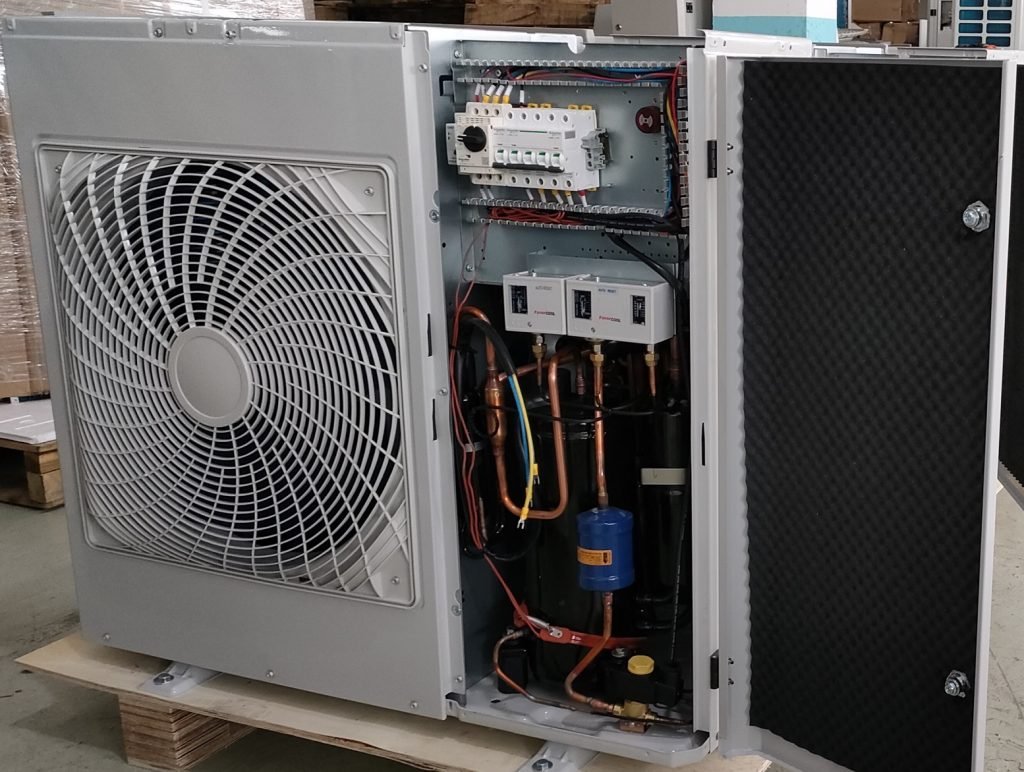
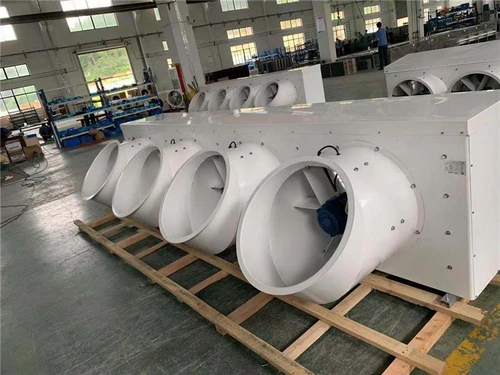
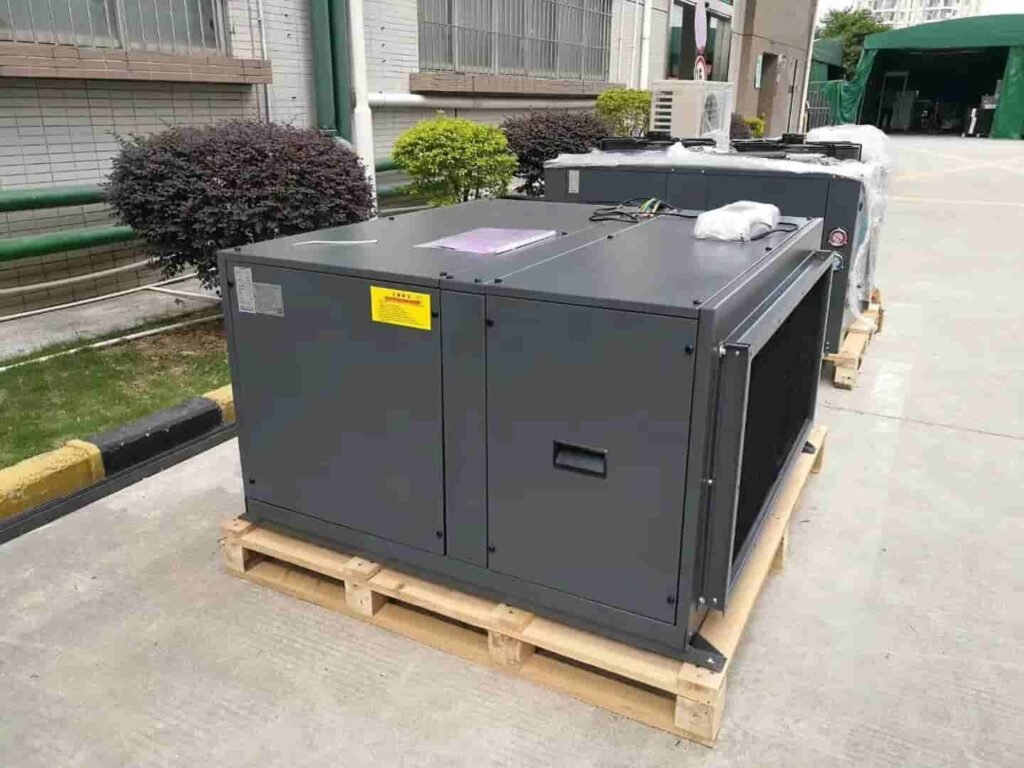
- Packaged condensing unit + ceiling‑mounted evaporator
-
-
Popular for small and medium cold rooms.
-
Easy to install and maintain.
-
-
Rack system for large plants
-
Central compressor rack with multiple cold rooms connected.
-
Better efficiency for big facilities and multiple temperature zones.
-
Conseils:
-
Use a reasonable safety margin in cooling capacity, but avoid oversizing.
-
For key rooms (for example a main frozen warehouse), consider redundancy (N+1 compressors or backup units).
2. Insulation and panel selection
Good insulation reduces energy consumption and keeps stable temperature.
Typical panel details for fish and seafood projects:
Key Selection Guidelines:
-
PU: Rentable, good insulation (λ=0.022 W/m·K)
-
PIR: Better fire resistance, slightly higher cost
-
Stainless steel skin: Essential for seafood corrosion (sel, sang, humidité)
-
Local climate adjustment: + 25~50mm thickness for hot/humid regions (>35°C ambient)
3. Anti‑corrosion design for seafood environment
Fish and seafood create a high‑salt, high‑moisture, and sometimes bloody environment.
If you ignore corrosion, you will face problems in a few years.
Important measures:
-
Use evaporators with anti‑corrosion coating and hydrophilic aluminum fins.
-
Protect wall areas that suffer from impact or frequent washing with stainless steel or special protective plates.
-
Use suitable floor coatings (for example epoxy or special anti‑corrosion, anti‑slip finishes).
-
Plan drainage points and slopes to avoid standing water.
These upgrades may increase initial cost a little, but they extend service life and reduce maintenance.
4. Evaporator layout and airflow
Good airflow keeps temperature uniform and avoids warm or frozen spots.
Design ideas:
-
Place evaporators so that cold air flows along aisles and between pallets, not directly against the door.
-
Keep distance between evaporator and products. Avoid blocking air return.
-
In blast freezers, use higher air speed to improve freezing speed, but protect products from excessive dehydration.
-
Choose defrost methods (electric, hot‑gas) according to room temperature and humidity.
5. Basic capacity and size calculation
When you design the room, consider:
-
Pallet size and stacking height
-
Type of racking system (block stacking or pallet racking)
-
Forklift or hand pallet truck operation space
-
Future expansion
You can prepare these data and share them with your supplier:
-
Maximum stock in tons for each product type
-
Expected turnover time (how many days stock stays in the room)
-
Number of pallets and pallet size
-
Available building space (length, largeur, height)

6. Energy consumption and operating cost
Most owners focus only on equipment price, but energy and maintenance costs over 5–10 years are often much higher.
Main factors that affect energy consumption:
-
Insulation thickness and quality
-
Efficiency of compressors, condenseurs, and evaporators
-
Door opening frequency and door type
-
Defrost method and schedule
-
Local ambient temperature and installation location (indoor/outdoor unit)
Common energy‑saving measures:
-
Use high‑efficiency or inverter compressors and efficient condensers.
-
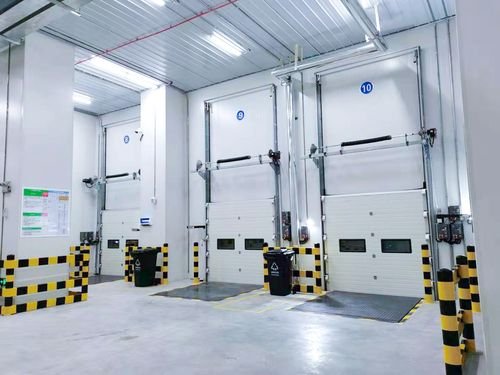
Install strip curtains, swing doors, or high‑speed doors at frequently used openings.
-
Use LED lights and turn them off automatically when no one is inside.
-
Set reasonable temperature and defrost cycles to avoid over‑cooling and over‑defrosting.
AVIS: If you want to know more information about cold storage design, please check our post »Comment concevoir et construire un entrepôt frigorifique?« .
Why You Need a Professional Cold Room for Fish and Seafood?
Cold rooms bring clear business value, not only “freshness”.
1. Lower loss and higher saleable volume
Without proper cold storage, you may lose products due to blackening, dehydration, and bacterial spoilage. A well‑designed cold room reduces these losses significantly.
For high‑volume traders and processors, even a 3–5% reduction in loss creates a big difference in yearly profit.
2. Longer shelf life and wider markets
Blast freezing and frozen storage extend the shelf life of many fish and seafood items to 6–12 months. This allows you to:
-
Buy in low‑price seasons and sell in high‑price seasons.
-
Ship products to more distant markets without quality complaints.
3. Stable quality and stronger brand
Stable temperature and good airflow keep meat texture, couleur, and flavor consistent. This protects your reputation with retailers, Restaurants, and export buyers.
4. Lower labor and management pressure
With a good cold room design and clear operation procedures, your team spends less time on emergency handling, re‑packing, and last‑minute selling of near‑spoiled goods. They can focus on procurement, production, and sales.

Daily Operation Tips for Fish and Seafood Cold Rooms
Buying a good cold room is only the first step. Daily use and management decide final results.
1. Contrôle de la température et de l'humidité
-
Set clear temperature targets for each room (for example 0–1°C for fresh fish, -18°C for frozen products).
-
Avoid frequent and long door opening. For busy doors, use strip curtains or high‑speed doors to reduce warm air infiltration.
-
Use a temperature recorder or remote monitoring system. Check trends regularly instead of only looking at the current reading.
2. Hygiene and product arrangement
-
Keep enough space between products and walls or evaporators so that air can flow freely.
-
Separate categories: raw vs cooked, fish vs shellfish, strong‑smelling vs neutral products.
-
Clean floors, drains, and walls on a regular schedule. Remove blood, slime, and ice build‑up as soon as possible.
3. Operation and maintenance
-
Follow “First In, First Out” (FIFO) or “First Expired, First Out” (FEFO) to reduce expired stock.
-
Check door seals, radiateurs, and hinges regularly to prevent ice build‑up and air leakage.
-
Follow the manufacturer’s maintenance plan for compressors and evaporators:
-
Inspect oil levels and pressures
-
Check fan motors and belts
-
Confirm defrost works correctly
-
Simple routine checks can prevent many major failures and save money.
Information You Should Prepare Before Asking for a Quote
To get a fast and accurate proposal from your cold room supplier or contractor, prepare the following basic information:
| Article | Description | Example |
|---|---|---|
| Business type | Your main operation model | Wholesale, processing plant, logistics center, restaurant central kitchen |
| Product types and percentages | Main products and their approximate share | 50% poisson, 30% crevette, 10% crab, 10% fruits de mer; small portion of tuna |
| Maximum storage quantity | Maximum stock for each room (in tons) | Frozen room: 80 tonnes; chilled room: 20 tonnes |
| Turnover days | How many days products stay in each room on average | Chilled room: 2–3 days; frozen room: 30–90 days |
| Required room types and temperatures | Types of cold rooms and their set temperature | 1 × chilled room 0–2°C; 1 × frozen room -18°C; 1 × blast freezer -35°C |
| Project location | Country and city of the project | Pays, City (Par exemple: Mexico, Mexico City) |
| Source de courant | Local voltage and frequency | 380V/3Ph/50Hz or 220V/1Ph/60Hz |
| Building size and height | Available internal length, largeur, and clear height | L 18 m × W 10 m × H 6 m |
| Handling equipment | How you move products inside the room | Hand pallet trucks only, or electric forklifts, reach trucks |
FAQ
Q1: How big a cold room do I need if I process 10 tons of fish daily?
100 tons storage (10-day turnover) = 200m³ product space = 60㎡ × 5m high cold room.
Recommendation: 1 chilled room (20 tonnes) + 1 frozen room (80 tonnes) + 1 blast freezer (daily 10 tons capacity, 6×8m).
Q2: How do I match blast freezer and frozen storage sizes?
Pour 10 tons daily production:
-
Surgélateur: 8×6m (freeze 10 tons in 2-4 heures, then transfer)
-
Frozen storage: 15×10m (holds 90 tons for 3 mois)
Ratio: Surgélateur : Frozen storage = 1:9 (floor area)
Q3: How do I plan for doubling production in 3 années?
Build main structure once, reserve space:
-
Wall positions: Leave 1.2m extra width for expansion
-
Roof clearance: Add 1m extra height for future racks
-
Pipe connections: Préparer 1 extra compressor connection + power panel
Cost increase: 8-10%, but no production stoppage needed after 3 années.
Q4: How much for 500-ton frozen storage? Basic vs premium specs?
Basic setup (couleur acier + standard unit): $1,200-1,500 per ton
Premium setup (acier inoxydable + efficient unit + monitoring): $1,800-2,200 per ton
Price gap: 30-50% more, but saves 20% electricity yearly, rembourse en 5 années.
Q5: How much more expensive are blast freezers vs regular cold rooms?
Blast freezers cost 2.5-3x per cubic meter than regular frozen rooms.
Pourquoi: 3x cooling power, 1x thicker insulation, special fans.
Worth it: Better freshness = happier customers = higher prices.
Q6: How many years will my cold room last? How to make it longer?
Normal lifetime:
-
Color steel panels: 8-10 années
-
Stainless steel panels: 12-15 années
-
Compressor units: 10-12 années (with maintenance)
3 ways to add 3-5 years life:
-
Stainless panels + epoxy floor: +4 années
-
Dégivrage automatique + contrôle de l'humidité: Less corrosion
-
Clean evaporator yearly: Compressor lasts 50% longer
How We Can Support Your Project?
We specialize in designing and manufacturing cold rooms for fish and seafood projects. Our team understands both the refrigeration technology and the real needs of seafood businesses.
We can provide:
-
Full cold room packages for chilled, frozen, blast freezer, and ultra‑low temperature rooms
-
Tailor‑made designs based on your product mix, capacité, and building conditions
-
Professional support for layout, flux d'air, panel selection, and anti‑corrosion solutions
-
On‑site installation guidance or complete installation service (depending on your country)
-
After‑sales support, spare parts supply, and remote technical assistance
If you plan a new fish or seafood cold room, or want to upgrade an existing one, you can send us your basic requirements.
We will help you choose the right combination of cold rooms and give you a practical solution that balances investment and long‑term operating cost.
Conclusion
En résumé, a professional cold room is essential for any serious fish and seafood business.
By choosing the right room types, temperatures and capacities, you keep products safe, fresh and consistent.
Proper insulation, airflow and anti‑corrosion design protect your investment and reduce energy bills.
With clear daily operation and simple maintenance, your cold room becomes a stable, efficient and profitable part of your supply chain.