Cold storage design isn’t just about choosing a refrigeration unit and insulated panels. A good solution should match your product, storage volume, flujo de trabajo, local climate, and long-term business plan.
If you design the cold storage well from the start, you can protect product quality, reduce energy costs, improve daily efficiency, and avoid expensive changes later.
What Is a Cold Storage and Why Design Matters
A cold storage is a temperature-controlled space used to store perishable or temperature-sensitive products, such as vegetables, frutas, carne, mariscos, productos lácteos, alimentos congelados, flores, productos farmaceuticos, or chemicals.
Good design is important because it affects:
-
Seguridad del producto
-
Cooling performance
-
Costo de construcción
-
Electricity consumption
-
Daily operating efficiency
-
Future expansion possibility
A poorly designed cold storage may still “run,” but it often causes slow cooling, uneven temperature, frequent frosting, high energy bills, difficult loading and unloading, and product quality problems.

Overall Cold Storage Structure
What Information Do You Need Before Design
Before you design a cold storage, collect the key project data first. If the input is wrong or incomplete, the design, equipment selection, and quotation will also be inaccurate.
If you can provide the above information before design, the cold storage supplier can usually offer a more suitable solution, avoid oversizing or undersizing, and reduce later modifications.
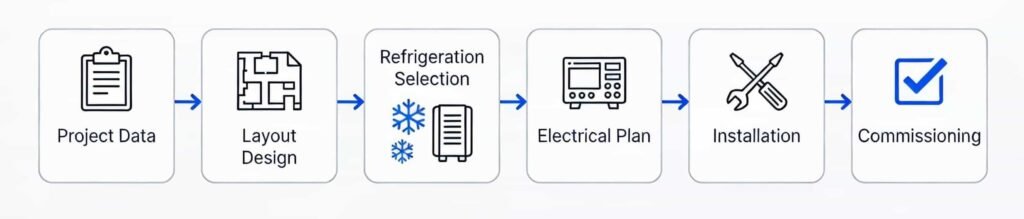
Cold Storage Design Flow Chart
How to Choose Your Right Cold Storage Type
Don’t start with the equipment. Start with the application.
Different cold storage projects serve different purposes.
The right type depends on the product, target temperature, and workflow.
Por ejemplo: a fruit distributor and a frozen meat processor don’t need the same cold storage design. Even if the room size looks similar, the temperature range, control de humedad, flujo de aire, and refrigeration load may be very different.
If you store different products, don’t force everything into one room. That often causes quality problems and higher running costs.
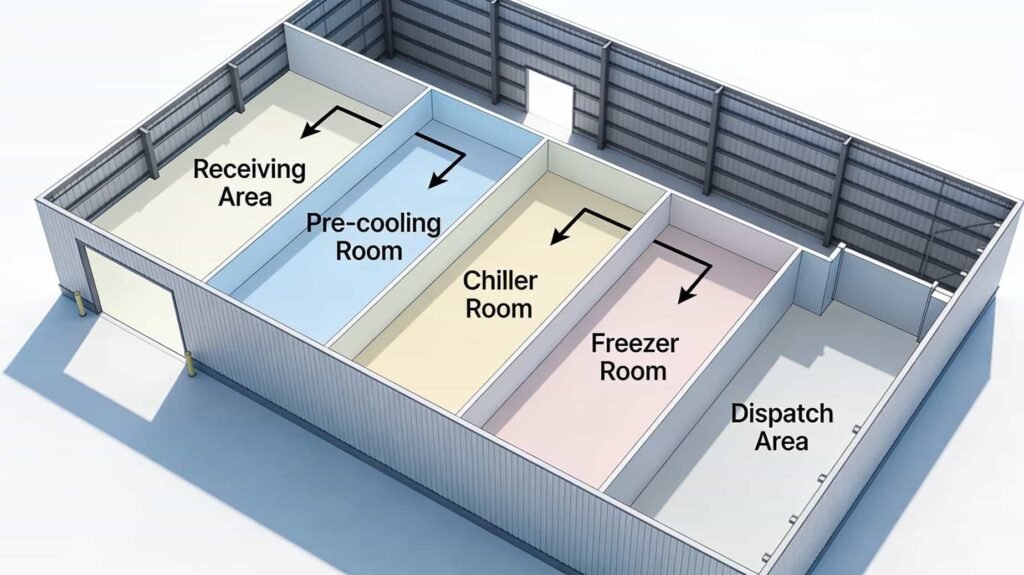
Multi-Temperature Zone Cold Storage Layout Plan
How to Determine the Right Size and Capacity
Many buyers ask one question first: “How big should my cold storage be?” The answer depends on more than storage volume.
You should size the room based on:
-
Maximum stock, not average stock
-
Product packaging and pallet size
-
Air circulation space
-
Aisle width
-
Loading and unloading space
-
Picking or sorting space
-
Future expansion
Por ejemplo: if a cold room can physically hold 100 pallets doesn’t always work well with 100 pallets packed tightly inside. Products need airflow. Workers and forklifts also need space to move safely and efficiently.
Aviso: When you plan size, think about how the room will operate every day, not just how much product it can hold on paper.
Cold Storage Layout and Workflow Design
A good cold storage is not only a cold room. It is a working system.
Layout design should reduce heat gain, improve loading efficiency, and support smooth product flow.
1. Receiving area
This is where products first arrive. If warm goods enter directly into the storage room, the room temperature may fluctuate significantly.
2. Pre-cooling or staging area
For some products, especially fruits, verduras, fresh meat, or processed food, a pre-cooling area helps reduce product temperature before final storage.
3. Main storage area
This is the core storage space. It should be designed according to pallet quantity, shelving type, and product turnover speed.
4. Picking and dispatch area
If products are frequently picked and shipped, a dedicated dispatch zone helps improve efficiency and reduce unnecessary door opening.
A practical layout should follow the shortest and simplest route:
Receiving → Pre-cooling → Storage → Picking → Dispatch
| Design point | Why it matters |
|---|---|
| Door location | Reduces unnecessary travel distance |
| Aisle width | Ensures safe movement of workers or forklifts |
| Evaporator position | Supports better air distribution |
| Buffer room / ante-room | Reduces hot air entering the cold room |
| Loading dock connection | Improves shipping efficiency |
| Workflow direction | Prevents congestion and improves operation |
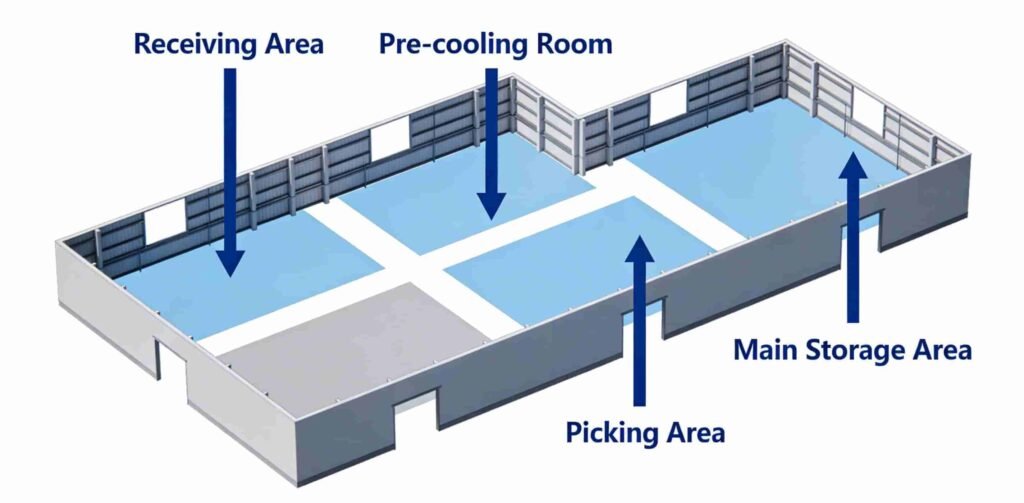
Cold Room Layout
Aviso: If products enter and leave the room often, layout matters even more. A poor layout can waste labor, increase energy use, and slow down operations every day.
Temperatura, Humedad, and Product Requirements
Temperature is important, but it isn’t the only factor.
Different products also need the right humidity, flujo de aire, and temperature stability. If you ignore these details, the room may run, but the product may still lose quality.
| Producto | Typical temperature | Humidity concern | Design note |
|---|---|---|---|
| Verduras | 0°C to 8°C | Usually important | Avoid excessive dehydration |
| Fruits | Depends on type | Important | Some fruits are sensitive to low temperature |
| Carne | Around 0°C to 4°C(fresh) or -18°C to -25°C (frozen) | Medio | Hygiene and stable temperature are important |
| Mariscos | Usually low temperature or frozen | Alto | Fast cooling is often critical |
| Lácteos | 2°C to 8°C | Medio | Stable temperature is important |
| Frozen food | -18°C or below | Lower concern | Temperature stability is key |
Por ejemplo: vegetables often need careful humidity control to reduce dehydration. Frozen food usually needs stable low temperature more than high humidity. Fresh seafood may need fast cooling right after processing.
This is why product type should guide the design from the beginning.
How to Choose Insulation Panels, Floor, and Doors
The enclosure system plays a major role in cold storage performance. It includes insulated panels, the floor system, y puertas.
1. Insulated Panels
Insulated panels reduce heat transfer from outside to inside.
The right panel type and thickness depend on the room temperature, el tamaño de la habitación, climate, and project budget.
| Room type | Typical temperature | Common panel thickness reference |
|---|---|---|
| Sala de refrigeración | 0°C to 8°C | 75~100mm |
| Sala del congelador | Below -18°C | 100~150mm |
| Congelador de explosión | Very low temperature | 200mm or above |
Don’t choose panels by price alone! Lower insulation performance can increase electricity costs for years.
2. Floor Design
The floor must support the expected load and stay dry, estable, and easy to clean.
Para cámaras frigoríficas, floor design is especially important. If you ignore floor insulation and moisture protection, you may face frost heave, piso agrietado, or condensation problems later.
A good floor design should consider:
-
Load capacity
-
Aislamiento
-
Moisture barrier
-
Surface durability
-
Drainage
-
Cleaning needs
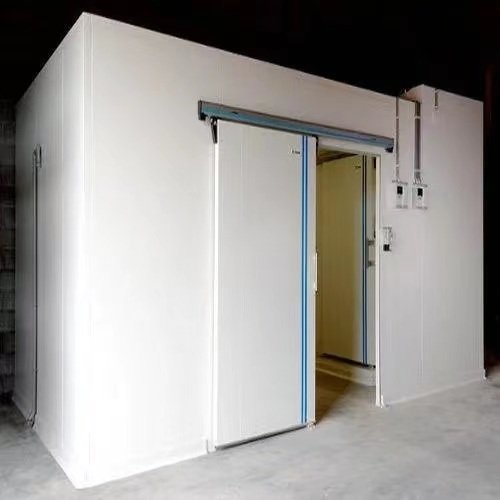
3. Doors
The door type should match how the room operates.
Aviso: If the cold room door is opened frequently, consider adding an air curtain or buffer room, which can reduce temperature loss and improve energy efficiency.
How to Select the Refrigeration System
Refrigeration system is the core of cold storage.
But the right system isn’t always the biggest or the most expensive one.
A good selection depends on:
-
El tamaño de la habitación
-
Temperatura objetivo
-
Tipo de producto
-
Daily turnover
-
Product inlet temperature
-
Required cooling speed
-
Temperatura ambiente
-
Installation conditions
-
Service and maintenance needs
-
Energy efficiency goals
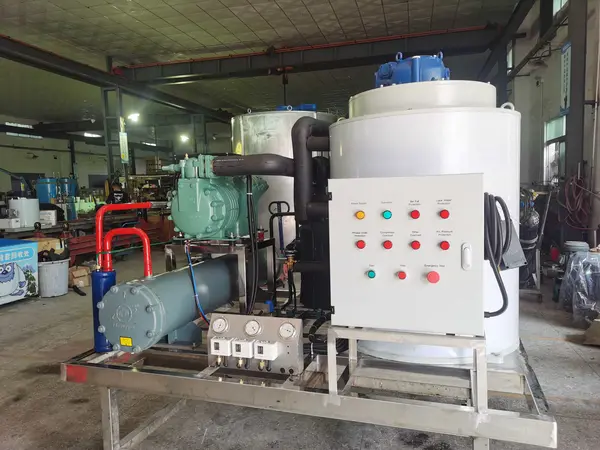
Main system parts include:
-
Compresor
-
unidad condensadora
-
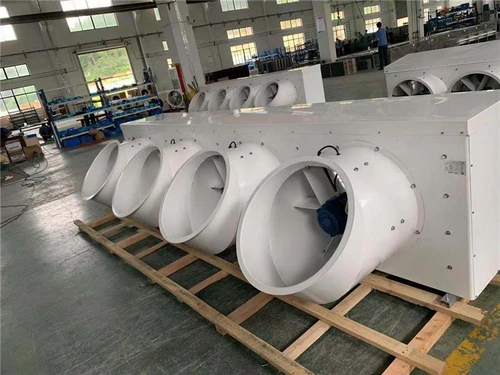
Evaporador
-
Refrigerante
-
Defrost control
If the customer needs fast pull-down, apertura frecuente de puertas, or heavy daily loading, the system should reflect that.
Don’t size equipment by room dimensions alone.
Electrical Control, Supervisión, and Alarm System
A modern cold storage shouldn’t depend only on manual checks.
A proper control system helps operators keep stable conditions, discover faults early, and reduce product loss risk.
A complete setup may include:
-
Temperature controller
-
Humidity monitoring
-
Data logger
-
High/low temperature alarm
-
Door opening alarm
-
Fault alarm
-
Automatic defrost control
-
Lighting control
-
Remote monitoring
For commercial projects, remote monitoring is especially useful.
It helps managers respond faster when temperature rises, equipment stops, or doors stay open too long, and reduce product loss risk.

Digital Remote Monitoring
Energy Saving and Operation Cost Control
Many buyers focus too much on purchase price and not enough on long-term running cost.
A cheap system may cost less at the beginning, but poor insulation, weak door sealing, wrong equipment sizing, or poor control logic can lead to high electricity bills and more service issues later.
To reduce operating cost:
-
Use suitable insulation
-
Choose doors with good sealing
-
Reduce unnecessary door opening
-
Add a buffer room when needed
-
Select efficient refrigeration equipment
-
Use LED lighting
-
Keep airflow paths clear
-
Clean heat exchangers regularly
-
Set practical temperatures, not excessively low ones
A good cold storage design should balance initial investment and long-term operating cost.
Cold Storage Design by Industry: Quick Reference
Cómo construir un almacenamiento en frío?
Cold storage construction is a technical project. It includes civil work, insulation installation, refrigeration installation, electrical work, drenaje, and final commissioning.
A typical process:
-
Confirm project requirements
-
Prepare layout and technical design
-
Check site conditions and utilities
-
Prepare the floor and structure
-
Install insulated panels and doors
-
Install refrigeration equipment
-
Install electrical control system and sensors
-
Check sealing, drenaje, and connections
-
Run commissioning tests
-
Complete final inspection and handover
Each step matters. Even high-quality equipment will not perform well if the installation quality is poor.
If the project includes a freezer room, the team should pay special attention to floor insulation, moisture protection, drenaje, and door sealing.
Installation and Commissioning Checklist
Before handover, inspect the system carefully. A clear checklist helps avoid disputes between supplier, installer, contractor, and end-user.
Do not skip the trial run. Real operation often reveals issues that aren’t obvious during installation.
Errores comunes para evitar
Many cold storage problems start during planning, not during operation.
Avoid these common mistakes in cold storage projects:
-
Choose room size by floor area alone
-
Ignore product inlet temperature
-
Forget future expansion
-
Mix products with different storage requirements
-
Use doors that are too small for real handling needs
-
Ignore floor insulation in freezer rooms
-
Under-estimate airflow and ventilation
-
Choose equipment by price only
-
Install no alarm or remote monitoring
-
Run the system without a maintenance plan
These mistakes can lead to unstable temperature, slow cooling, higher power use, and expensive rework.
Preguntas frecuentes
Q1: Should I oversize the condensing unit if my country has very hot summer temperatures?
Don’t oversize blindly.
Size the unit for the real heat load and the local peak ambient conditions.
In hot climates, choose a high-ambient model or design conditions that match your site, because standard ratings may not hold capacity at high outdoor temperatures.
Q2: How should I choose racking if my cold room is for turnover storage or long-term storage?
Choose the racking based on product flow.
For high-turnover storage, use layouts that support fast access and fast picking; for long-term storage, use higher-density racking to save space.
Also check pallet type, forklift route, aisle width, and FIFO (First in/first out) or LIFO (Last in, primero en salir) needs before you decide.
Q3: Does the floor need anti-frost protection or floor heating? At what temperature should I consider it?
Para cámaras frigoríficas, you should seriously consider underfloor frost protection.
Once the floor and soil below can freeze, you risk frost heave, piso agrietado, y daños estructurales a largo plazo.
In practice, this becomes a key design issue for subzero freezer applications, not just normal chilled rooms.
Q4: Is an air curtain enough if the door opens dozens of times a day? Do I need an ante-room or buffer room?
An air curtain alone is often not enough for heavy traffic.
If the room opens many times a day, especially in hot or humid climates, add a buffer room, fast door, strip curtain, or a combination of these measures.
This helps reduce warm air ingress, frost, and energy loss.
Q5: How should I choose the refrigerant? Do environmental rules affect the decision?
Choose the refrigerant ( R404/507/448/449/290…) based on application, eficiencia, service support, and local rules.
Sí, environmental rules matter.
Many markets now restrict or phase down high-GWP HFC refrigerants under F-gas rules or Kigali-related policies, so you should confirm what is legal and serviceable in your country before you finalize the design.
Q6: Can a local team repair the system if it breaks down? How long will spare parts take?
Ask this before you buy!
Check whether the supplier has local service partners, standard spare parts, wiring diagrams, controller access, and remote support.
Also ask for a spare-parts list and lead times for critical items such as controllers, sensores, aficionados, contactores, valvulas, and compressor parts.
P7: How can I tell if a supplier offers a low-price but low-spec solution?
Check the details, not just the total price!
A low-spec offer often hides undersized capacity, thinner insulation, weaker door hardware, limited controls, no alarm or monitoring, no frost-protection design, or poor after-sales support.
Ask each supplier to state the design temperature, ambient condition, panel thickness, refrigeration capacity, refrigerante, control scope, included accessories, and warranty in writing.
Need a Cold Storage Solution for Your Project?
Send us the following information:
-
Tipo de producto
-
Required room temperature
-
Room dimensions
-
Project location
-
Local power supply
-
Estimated storage volume
-
Daily in/out quantity
Our team can help you prepare a suitable cold storage solution based on your actual project needs.
Conclusión
A successful cold storage project starts with clear requirements and practical design. El tamaño de la habitación, flujo de trabajo, aislamiento, refrigeración, controls, installation quality, and energy use all affect the final result.
If you plan the project well from the beginning, you can build a cold storage that protects your products, supports daily operations, and controls long-term cost.