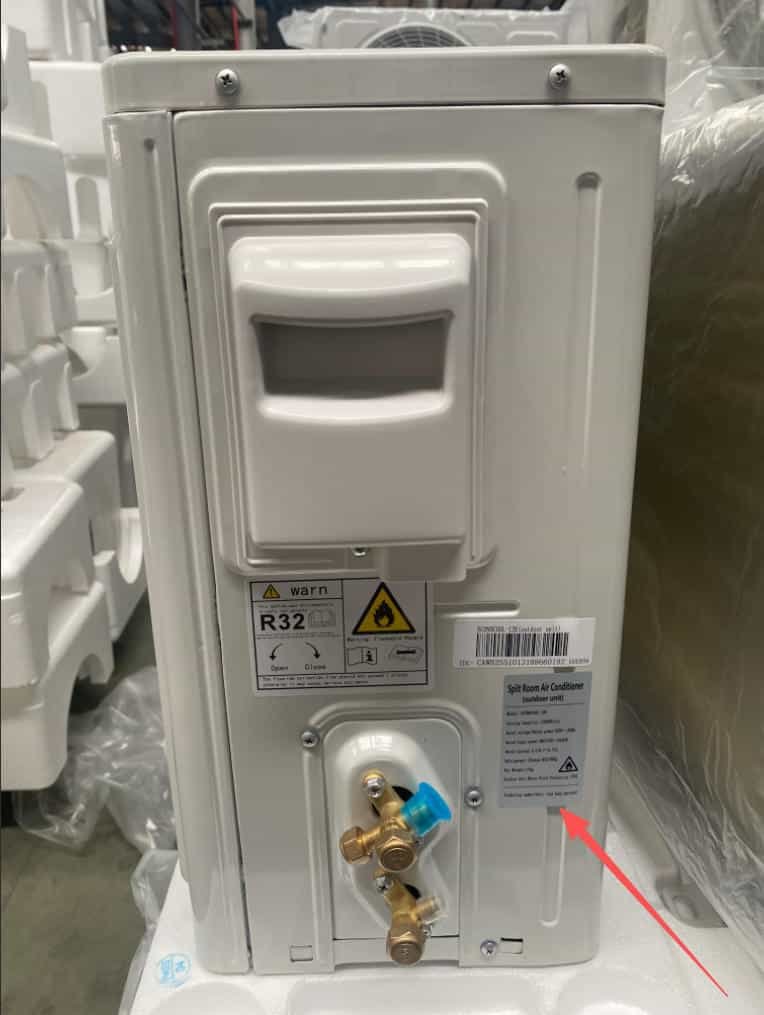
Subsequent letters:
-
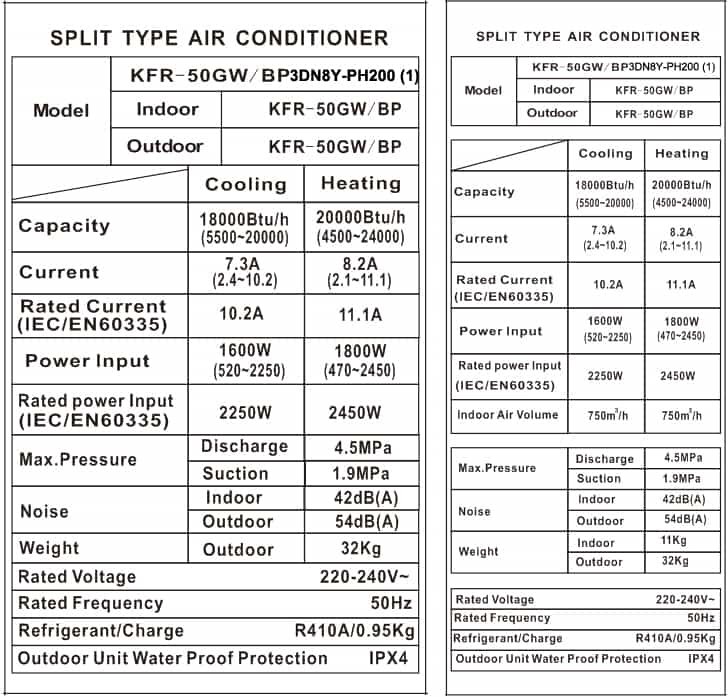
G: Represents Wall-mounted indoor unit (Cabinet unit is “L”)
-
W: Represents Outdoor unit
Additional function codes (e.g., BP3DN8Y):
-
BP: Inverter (non-inverter air conditioner models don’t have this identifier)
-
3D: Represent 3D Airflow or Intelligent Temperature Control
-
N: Represent Eco-friendly Refrigerant (e.g., R410a or R32)
-
Y: Remote control function
Energy Efficiency Label (e.g., PH200 (1)):
-
The number “1” represents Level 1 Energy Efficiency (A lower level indicates higher energy savings).
Cooling/Heating Capacity: Unit is W. A higher value indicates stronger cooling/heating ability (e.g., Cooling Capacity 5000W, Heating Capacity 5500W).
Cooling/Heating Power Input: Unit is W. Represents the power consumption during cooling/heating operation (lower power input means higher energy savings. This should be evaluated together with the energy efficiency rating for a more accurate assessment).
Auxiliary Electric Heating Power: Some air conditioners require auxiliary electric heating during heating mode. Unit is W. This power consumption is additional.
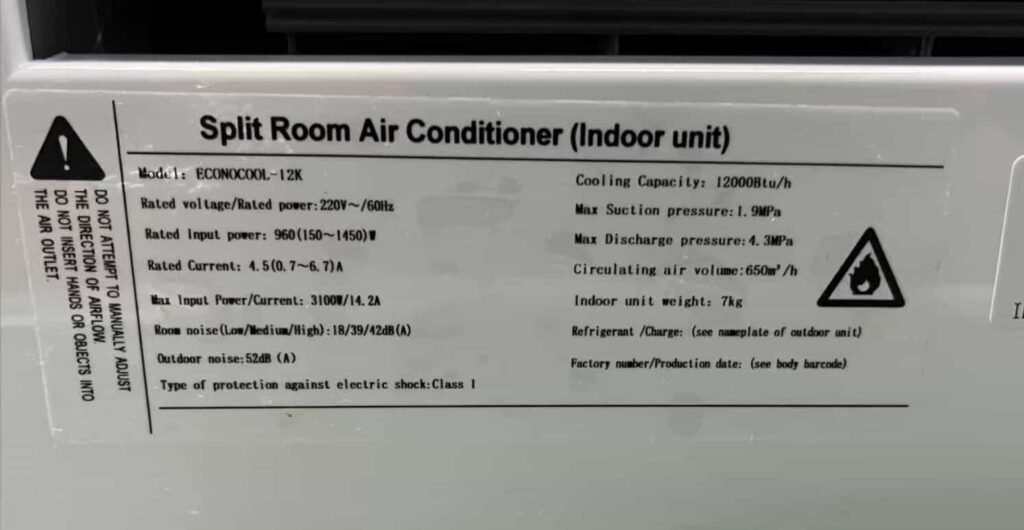
Capacity: Cooling 18,000btu/h means rated cooling capacity (btu is an energy unit to measure air conditioner), 5,500~20,000btu/h means INVERTER air conditioner cooling capacity scope at different ambient temperature (non-inverter air conditioner no this scope).
Current: Cooling 7.3A means smooth operation current on cooling mode, 2.4~10.2A means INVERTER air conditioner cooling current scope at different ambient temperature (non-inverter air conditioner no this scope).
IEC/EN60335: International standard for air conditioner with excellent performance.
Energy Efficiency Ratio (APF/SCOP):
-
For inverter air conditioners, refer to APF (Annual Performance Factor).
-
For non-inverter air conditioners, refer to EER (Energy Efficiency Ratio).
A higher value indicates better energy efficiency (Typically, Level 1 Energy Efficiency requires an APF ≥ 4.5).

Max. Pressure discharge (high side): 4.5 MPa
Max. Pressure suction (low side): 1.9 MPa
Refrigerant Charge: Max filling weight
What Does KFR Mean on an Air Conditioner?
The model number usually starts with “KFR” which is a common designation in systems like China’s GB standards. Here is a breakdown:
-
K: Stands for “Air Conditioner”
-
F: Stands for “Split Type” This indicates the unit has separate indoor and outdoor units.
-
R: Stands for “Heat Pump.” This means the unit can provide both cooling and heating.
Therefore, “KFR” designates a Split-Type Heat Pump Air Conditioner.
A model that only has “KF” would be a cooling-only split system. The numbers following these letters often indicate the cooling capacity (see above).
KFRd: The “d” represents auxiliary electric heating, meaning that in addition to the heat pump, it also supports auxiliary electric heating to enhance heating performance.
KC: Represents a window-mounted air conditioner, which is a single unit integrating both the indoor and outdoor sections, and installed in a window.
Model Number vs Serial Number: What’s the Difference?
Many people confuse the model number with the serial number, but they are not the same.
The model number identifies the product family, design, and configuration. It’s useful for product selection, spare parts identification, and general technical reference.
The serial number identifies one specific unit. It is mainly used for traceability, warranty, manufacturing records, and service history.
If you contact a supplier or service team, it is often best to provide both the model number and the serial number.
Why the Nameplate Matters to Different Users
The same nameplate can be useful to different people for different reasons.
For Homeowners
Homeowners usually want to know what type of AC they have, what refrigerant it uses, what the capacity is, and whether the unit has cooling only or both cooling and heating.
For Buyers and Importers
Buyers and importers often focus on model identity, voltage, frequency, refrigerant, certifications, and traceability. These details help confirm whether the product is suitable for a target market.
For Installers
Installers need to verify the power supply requirements, system matching, and key operating specifications before installation. The nameplate helps reduce compatibility mistakes.
For Technicians
Technicians use the nameplate to identify the exact unit, verify refrigerant type, check electrical data, review pressure limits, and support troubleshooting or spare parts matching.
Common Mistakes When Reading an Air Conditioner Nameplate
Here are some of the most common mistakes:
-
Confusing the model number with the serial number
-
Assuming all brands use the same coding logic
-
Thinking cooling capacity is the same as electrical power consumption
-
Looking at only one label when both indoor and outdoor units should be checked
-
Ignoring voltage, frequency, or phase information
-
Treating certification marks as performance ratings
What the Nameplate Can’t Tell You
Even a detailed nameplate does not contain everything.
For example, the nameplate usually does not fully explain:
-
Maximum piping length
-
Maximum elevation difference
-
Static pressure performance
-
Airflow curves
-
Defrost logic
-
Low ambient heating performance
-
Noise test conditions
-
Full troubleshooting procedures
For those details, users should consult the installation manual, product specification sheet, or service manual.
FAQs
Q1: What is an air conditioner nameplate?
It is the identification label attached to the unit that shows key technical and product information.
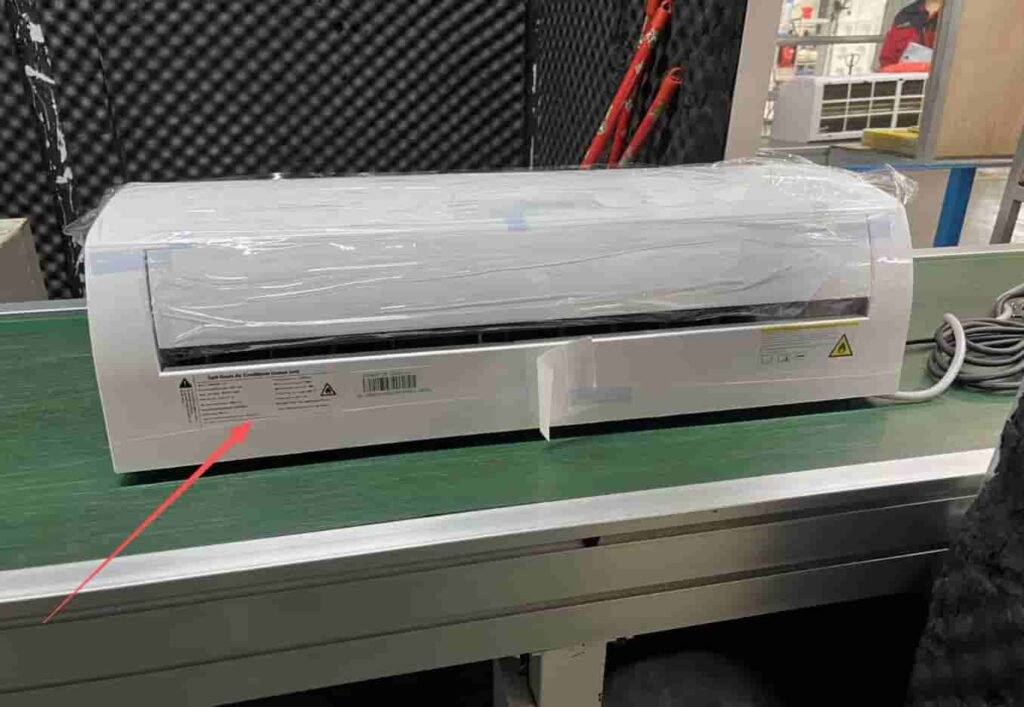
Q2: Where is the nameplate on an AC unit?
It is often located on the side, back, or service panel area of the unit. Split systems may have labels on both the indoor and outdoor units.
Q3: Is the model number the same as the serial number?
No. The model number identifies the product type or series, while the serial number identifies the individual unit.
Q4: What does KFR mean?
In many Chinese naming systems, KFR refers to a “split-type heat pump air conditioner”.
Q5: Can I identify the refrigerant from the nameplate?
Yes. In most cases, the refrigerant type is listed on the nameplate, such as R32 or R410A.
Q6: Does the nameplate show power consumption?
Usually yes. It may show rated input power and rated current, but these should not be confused with cooling capacity.
Q7: Can I use the nameplate to find spare parts?
Yes. The model number and serial number are often needed when checking spare parts compatibility.
Q8: Are all AC model numbers decoded the same way?
No. Model number structures vary by manufacturer, product line, and market.
Conclusion
Understanding the nameplate parameters of air conditioner is a fundamental skill for both users and installation or maintenance personnel.
Each piece of data on the nameplate reflects the unit’s performance, safety, and energy consumption level.
Only by truly understanding these parameters can you select the right model, install it properly, and use it efficiently—allowing the air conditioner to deliver optimal performance and enjoy a longer service life.