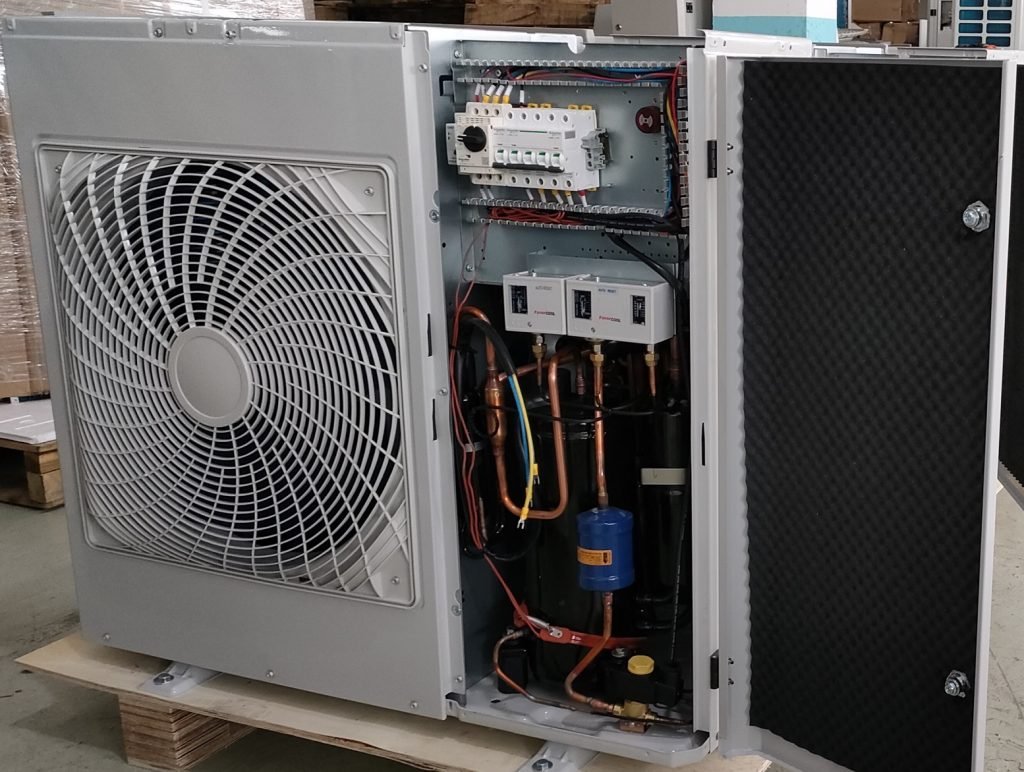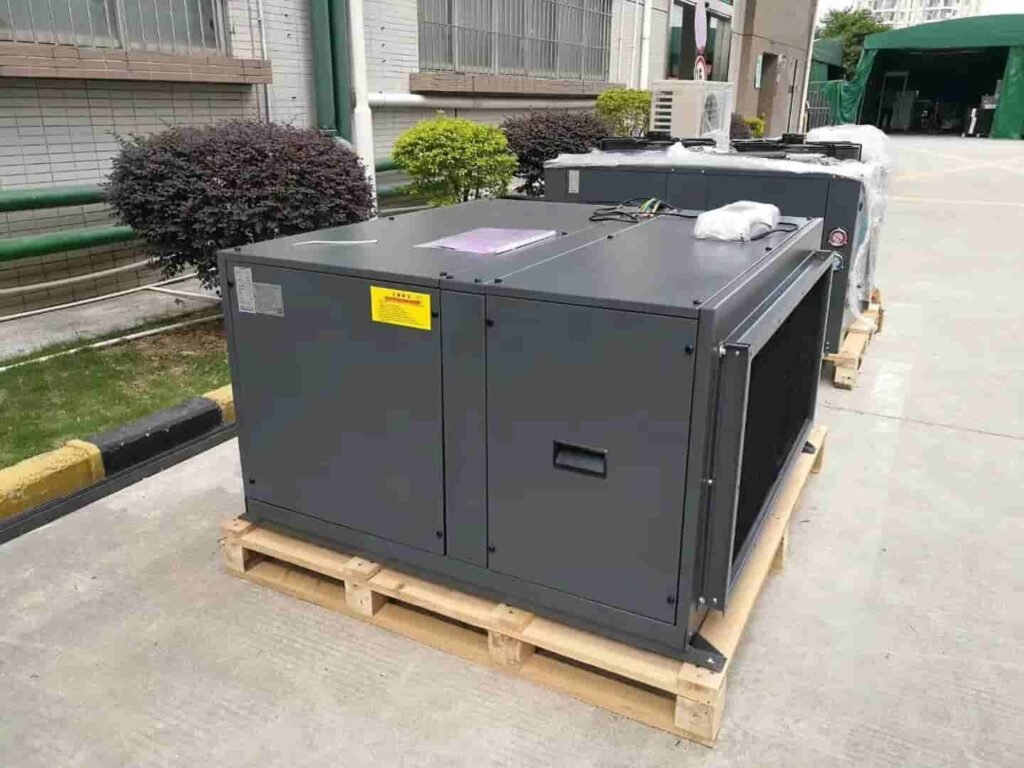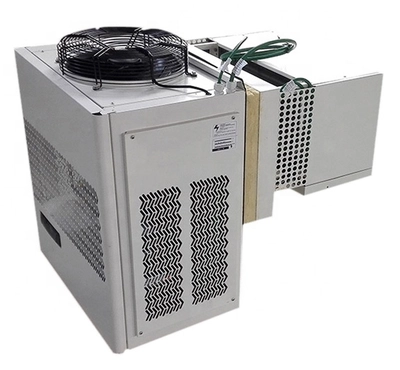
Using one condensing unit for multiple cold rooms means one outdoor Đơn vị ngưng tụ supplies refrigerant to two or more evaporators, usually one evaporator for each room, through a shared liquid line and a shared suction return.
This setup can lower equipment cost, save outdoor space, and simplify maintenance. Tuy nhiên, it only works well when the room temperatures, load conditions, piping design, and control logic all match the application.
The key idea is simple: each phòng lạnh must cool independently.
One room should call for cooling, reach set temp, and stop cooling without forcing the other rooms to overcool or lose control.
When This Design Makes Sense
A one-condensing-unit multi-room design works best when the phòng lạnh have similar temperatures and similar operating conditions.
Good Applications:
| Project Type | Suitability | Tại sao |
|---|---|---|
| Two or more chiller rooms | Good | Similar room temperatures make control easier |
| Two or more freezer rooms | Usually good | Same suction condition works better |
| Several small cold rooms in one facility | Good | Saves space and reduces equipment quantity |
| Projects with limited outdoor installation area | Good | One condensing unit needs less space |
Applications That Need Extra Care:
If all rooms stay close in temperature, one shared suction condition can often support the whole system. If one room runs as a freezer and another runs as a chiller, the design needs extra pressure control.
How the System Works
In this design, các Đơn vị ngưng tụ acts as the refrigeration source, and each cold room acts as an independent cooling zone.
Each room usually includes its own control and refrigerant feed components.
Basic Component Layout:
The thermostat in each room controls that room’s solenoid valve.
When the room temperature rises above setpoint, the thermostat opens the solenoid valve. Refrigerant then flows to that room’s evaporator. When the room reaches setpoint, the thermostat closes the solenoid valve and stops refrigerant flow to that room.
This setup gives each room independent on/off cooling control while all rooms share one condensing unit.
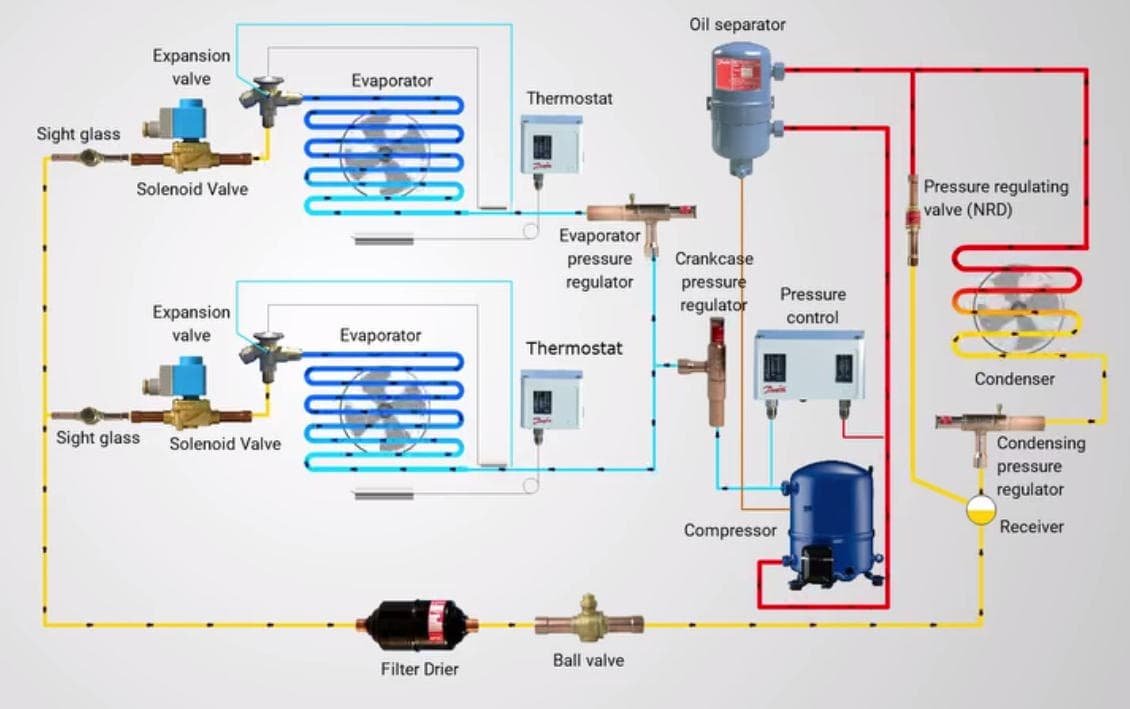
Multiple Cold Rooms Refrigeration Circuit
Same-Temperature Rooms: The Simplest Configuration
Same-temperature rooms create the simplest and most reliable one-to-many setup.
Ví dụ, if you have three phòng lạnh at +2°C, +3°C, and +4°C, one shared condensing unit often works well because the system can use a similar suction condition for all three rooms.
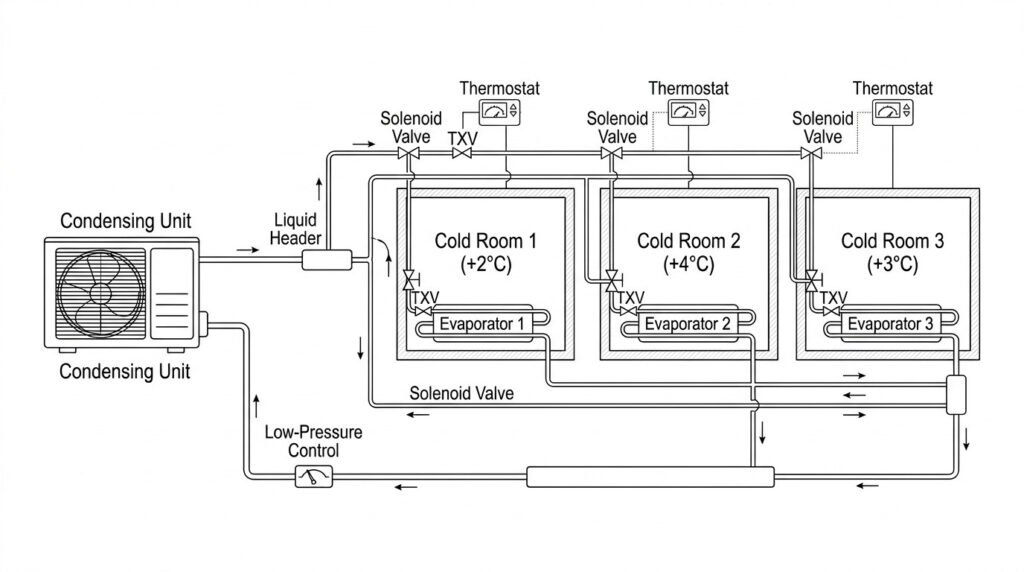
Same-Temperature System Layout:
Why This Layout Works Well:
Trong loại dự án này, the system usually controls well as long as the load calculations, đường ống, and component selection are correct.
Mixed-Temperature Rooms: Chiller and Freezer on One Unit
When one Đơn vị ngưng tụ serves a chiller and a freezer, the design becomes more difficult.
The reason is: the freezer needs a lower suction pressure.
If the chiller shares that same low suction condition directly, the chiller evaporator can run too cold. That can cause overcooling, coil icing, unstable room temperature, or even product freezing inside the chiller.
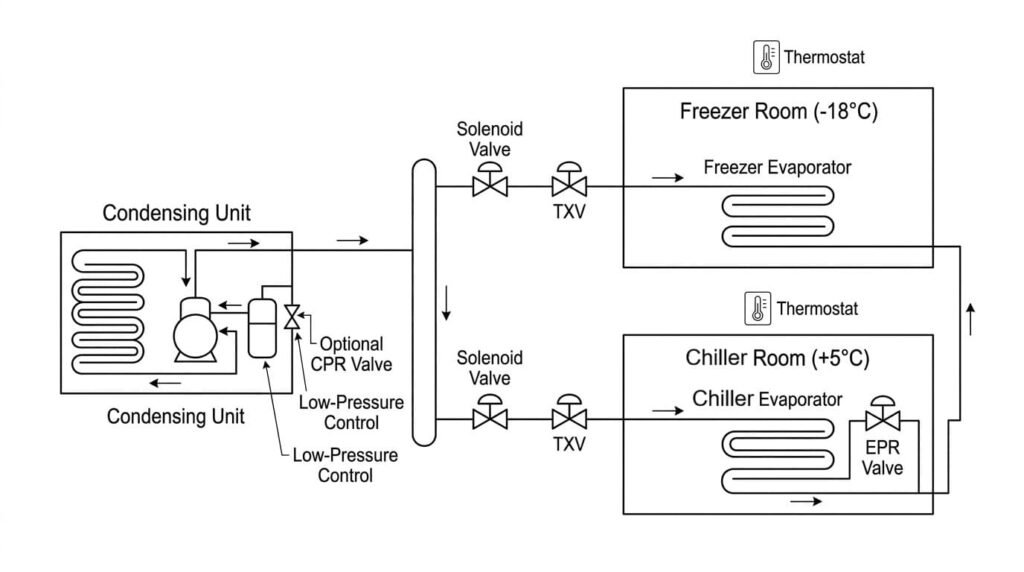
Ví dụ:
Trong tình huống này, a basic shared system usually doesn’t perform well by itself.
The chiller room branch often needs an EPR valve.
What an EPR Valve Does
An EPR valve helps the warmer room keep a higher evaporator pressure.
You usually install the EPR valve in the suction line of the warmer room, after the evaporator and before the common suction header.
EPR Valve Logic:
With this arrangement:
-
The freezer branch follows the lower suction condition it needs.
-
The chiller branch stays at a higher evaporator pressure because the EPR valve holds it there.
That is how one condensing unit can serve two different temperature rooms more safely.
When should use a EPR Valve
- If the room temperature difference stays within 5°C, one condensing unit usually works well for both rooms. Control stays simpler and the system runs more steadily. No need EPR valve.
- If the temperature difference goes beyond 8°C ~ 10°C, can’t treat it as a simple shared-unit setup. You usually need to evaluate the system and add an EPR valve, especially for a chiller-plus-freezer combination.
Ví dụ: a +5°C chiller room and a -18°C freezer room have a large temperature gap, so you should usually add an EPR valve. Nếu không thì, the chiller branch can run too cold.
When a CPR Valve May Help
Some projects also need a CPR valve near the compressor suction.
A CPR valve protects the compressor during startup or hot pull-down. If several rooms call for cooling at the same time, or if warm product enters the rooms, suction pressure can rise quickly. That high suction pressure can overload the compressor.
CPR Valve Logic:
| Câu hỏi | Trả lời |
|---|---|
| Why use a CPR valve? | Protect compressor during heavy load conditions |
| Where do you install it? | Near the compressor suction |
| When is it useful? | Hot pull-down, heavy startup load, mở cửa thường xuyên |
| Does every project need it? | KHÔNG, but some mixed-load or heavy-load projects do |
How Cooling Capacity Is Distributed
This is one of the most common questions from customers:
If one Đơn vị ngưng tụ serves several rooms, how does the system divide the cooling capacity?
The short answer is: the system doesn’t divide cooling by guesswork. Proper component selection determines how the system distributes cooling.
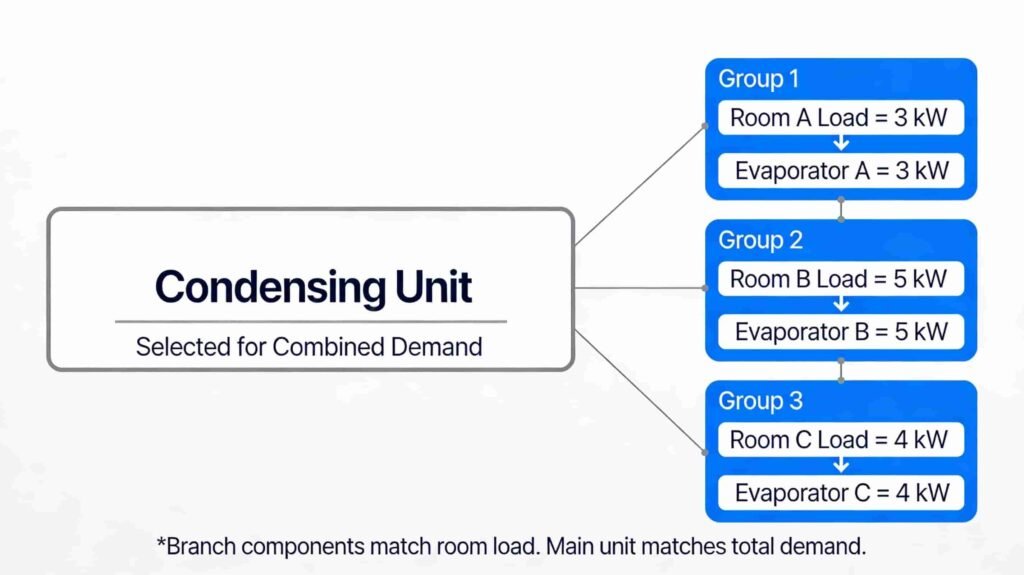
Cold Room Cooling Distribution
Capacity Distribution Logic:
Ví dụ:
Sample Load Breakdown:
Selection Result:
Each evaporator handles the load of its own room. The condensing unit covers the total demand when multiple rooms call for cooling at the same time.
That means:
-
You needn’t manually assign “30% cooling” to one room and “70%” to another room.
-
You size each branch correctly.
-
You size the main unit for the combined demand.
Simple Rule Table
This table helps customers understand when a basic one-to-many system works and when it needs extra controls.
When to Use a Simple System and When to Add Pressure Control:
How to Configure the System Step by Step
A good one-condensing-unit multi-room design usually follows this process:
Bước chân 1: Confirm Basic Project Data
Bước chân 2: Calculate the Load for Each Room
You should calculate each room separately.
Main Load Items:
This step gives you the required evaporator capacity for each room.
Bước chân 3: Select One Evaporator for Each Room
Don’t make all evaporators the same unless the rooms truly have the same load and same operating conditions.
Bước chân 4: Select the Condensing Unit for Combined Demand
This step is where many projects go wrong.
Some people size the Đơn vị ngưng tụ only by looking at one room. That approach often creates trouble during startup, heavy use, or simultaneous cooling demand.
Condensing Unit Selection Checklist:
The condensing unit must match the system demand under real operating conditions, not just ideal lab conditions.
Bước chân 5: Design the Refrigerant Piping
A multi-evaporator system needs good piping design because it must work in both full-load and part-load conditions.
Piping Rules:
A system may run with all rooms cooling together today, then only one small room may call for cooling tonight. Your piping must support both conditions.
Bước chân 6: Add Room-by-Room Controls
Independent room control is the heart of a multi-room system.
Standard Control Arrangement:
Each room should control its own refrigerant feed. Without that, one room can keep cooling when it no longer needs cooling.
Bước chân 7: Use Pump-Down Control
Pump-down control helps protect the compressor.
Pump-Down Sequence:
This method helps reduce liquid refrigerant migration during off cycles.
Bước chân 8: Plan Defrost for Each Room
Different rooms often build frost at different rates.
Defrost Factors:
It is usually better to stagger defrost schedules instead of defrosting all evaporators at the same time.
Ví dụ 1: Three Similar Chiller Rooms
This example shows a standard same-temperature project.
Project Data:
Because the room temperatures are close, one shared condensing unit usually makes sense.
Recommended Configuration:
Operating Logic:
This type of project gives the best balance of simplicity, trị giá, và hoạt động ổn định.
Ví dụ 2: One Chiller and One Freezer
This example shows a mixed-temperature project.
Project Data:
Recommended Configuration:
Operating Logic:
This design can work well, but it needs better pressure control and more careful setup than a same-temperature system.
Ví dụ 3: Energy Consumption Comparison
Câu hỏi: “How much electricity can 1 condensing unit save when it serves 3 phòng lạnh, compared with using 3 separate condensing units?”
Tốt, there is no fixed number.
For a project like the example above: one condensing unit serves 3 phòng lạnh usually saves about 5% ĐẾN 15% điện (if you use inverter condensing unit can save roughly 25% ĐẾN 35%) compared with 3 separate condensing units when the rooms have similar temperatures, similar operating hours, and good piping design.
Simple answer:
Why one unit can save power:
-
One larger condensing unit often runs more efficiently than three small units.
-
A shared system can reduce cycling losses.
-
One system can use capacity more smoothly when room loads change.
But savings can disappear:
Easy example:
If 3 separate units use 100 kWh/day, one shared unit for the same 3 similar rooms may use about 85 ĐẾN 92 kWh/day.
ĐỂ Ý: Actual savings depend on room temperature, load diversity, đường ống, and control design.
Common Mistakes
Most Common Design Errors:
Phần kết luận
One condensing unit can run multiple cold rooms well when you match room temperatures, size each evaporator correctly, and design the controls and piping with care.
For mixed-temperature projects, add the right pressure controls, such as EPR, to protect room stability and product quality. A well-planned one-to-many system can lower cost, tiết kiệm không gian, and deliver reliable performance.